Solar Camera vs WiFi CCTV: Which One Actually Works in South Africa?
If you’re trying to secure your home without getting ripped off or left with a system that dies every time Eskom flips the switch, you need to understand the real difference between solar camera vs WiFi CCTV before you spend a rand. Both are wireless. Both connect to your phone. But they are not the same thing — and in South Africa’s unique environment of load shedding, dusty conditions, and tight budgets, the differences matter more than any spec sheet will tell you. This article breaks it all down honestly so you can make the right call for your property.
The Ultimate Guide to Solar Security Cameras in South Africa
Solar Camera vs WiFi CCTV: What’s the Actual Difference?
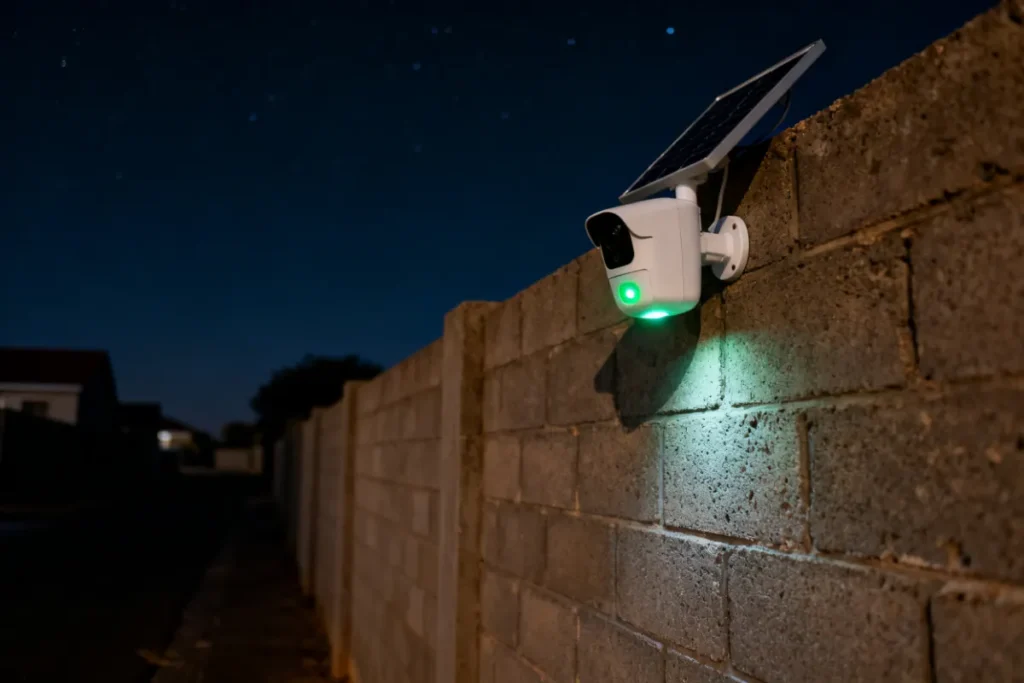
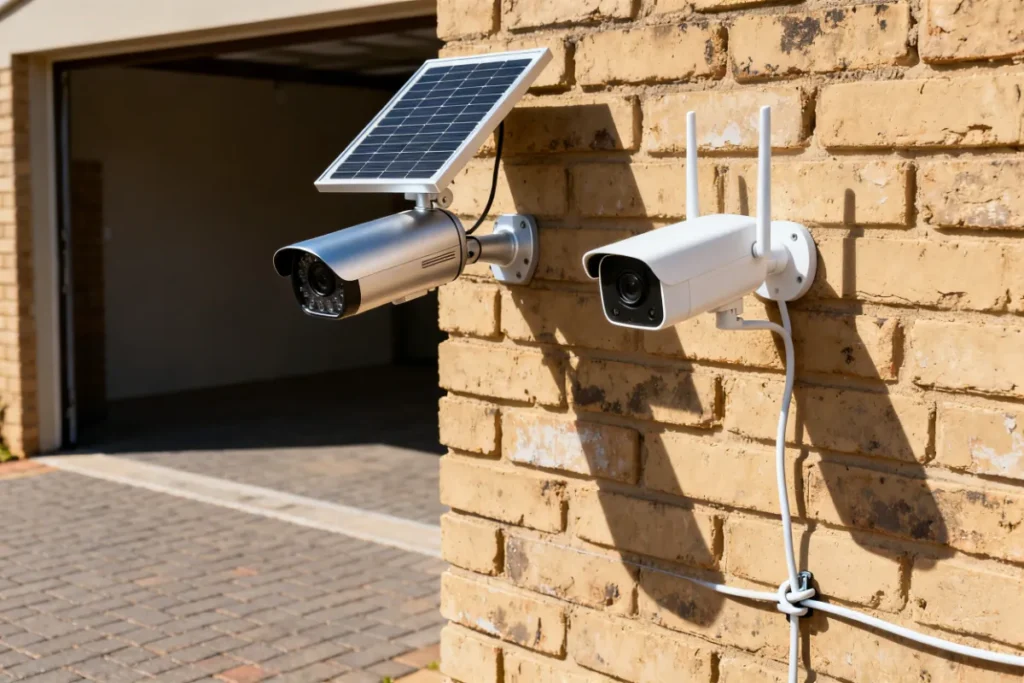
A solar camera is self-powered — it has a built-in solar panel and rechargeable battery that keep it running independently of your home’s electricity supply. A WiFi CCTV camera also connects wirelessly to your network, but it still needs a power source, which means it’s plugged into a wall socket or wired into your electrical system. The “WiFi” part only describes how it communicates, not how it gets its power. That one distinction changes everything about how each system performs during load shedding.
Think of it this way: a solar camera is a standalone unit that charges itself and keeps recording whether your power is on or not. A WiFi CCTV camera is dependent — cut the power and you cut the camera, unless you’ve got a UPS or backup battery system in place. For most South African homeowners, that dependency is a serious problem.
How Each System Handles Load Shedding
Load shedding is where the solar camera vs WiFi CCTV debate gets decided for most South Africans. Solar cameras keep running through every stage of load shedding because they draw zero power from the grid. As long as the battery is charged from the previous day’s sunlight, the camera records, detects motion, and sends alerts to your phone uninterrupted.
WiFi CCTV cameras go dark the moment your power goes out — unless you’ve invested in a Mini UPS to keep both the camera and your router powered during outages. A decent UPS adds cost and complexity to what should be a simple setup. It also means you have another device to maintain, another battery to replace, and another failure point in your security system. In Stage 4 or Stage 6 conditions, that’s a lot of risk to carry.
Cost Comparison: Solar Camera vs WiFi CCTV in South Africa
Price is always part of the conversation for South African buyers, so let’s be straight about what each system actually costs — upfront and over time.
| Cost Factor | Solar Camera | WiFi CCTV Camera |
|---|---|---|
| Camera unit cost | R800–R3,000 | R600–R2,500 |
| Installation cost | DIY — R0 | DIY or electrician R0–R1,500 |
| UPS/backup power needed | No | Yes (R500–R2,000 extra) |
| Monthly electricity cost | R0 | R15–R40 per camera |
| SD card needed | Yes (R80–R200) | Yes (R80–R200) |
| Maintenance cost | Minimal (panel cleaning) | Minimal |
| Total Year 1 estimate | R880–R3,200 | R1,195–R6,200 |
The solar camera looks comparable or slightly more expensive upfront, but once you factor in the UPS requirement and ongoing electricity cost for WiFi CCTV, the solar option is almost always cheaper over a 12-month period. Over two to three years, the gap widens significantly.
Image Quality: Does One Outperform the Other?
Both solar cameras and WiFi CCTV cameras are available in 1080p and 4K resolutions, so neither has an inherent image quality advantage based on type alone. What affects image quality most is the specific model you buy, the lens quality, the night vision technology, and how well you’ve positioned the camera. A well-positioned 1080p solar camera will produce more useful footage than a poorly mounted 4K WiFi CCTV camera every single time.
Night vision is where some budget solar cameras fall short compared to mid-range WiFi CCTV units. Solar cameras need to conserve battery power, which means some models use lower-power IR LEDs that have a shorter night vision range — typically 5–10 metres versus 15–20 metres on a powered WiFi unit. If night vision range is critical for your property, check the spec sheet carefully before buying. Our 4K Solar Camera handles this well without compromising battery life.
Installation: Solar Camera vs WiFi CCTV Setup Difficulty
Solar cameras win on installation ease — no contest. You mount the bracket, connect to WiFi through the app, and you’re done. No cable runs, no electrician, no chasing wires through walls. Most solar camera setups are complete in under 30 minutes. For renters, people in complexes, or anyone who doesn’t want to touch their walls, this is a major advantage.
WiFi CCTV cameras that are truly wireless (battery-powered with WiFi) are similar to install, but the ones that need a power cable require you to either run an extension cord (which looks terrible and is a security risk) or have an outdoor power point nearby. If you don’t have one, you’re looking at an electrician’s call-out fee before the camera is even on the wall. For a full walkthrough of the solar installation process, read our Wireless Solar Camera Setup guide.
Which One Is Right for Your SA Property?
The right choice depends on your specific situation, not a generic recommendation. Use this guide to match your circumstances to the best option.
Choose a solar camera if:
- You rent your property and can’t make permanent electrical changes
- Your property experiences regular load shedding (Stage 2 or higher)
- You need to cover a remote area like a gate, farm boundary, or outbuilding far from power points
- You want a DIY setup with zero ongoing electricity cost
- You’re covering a location with good daily sun exposure
Choose a WiFi CCTV camera if:
- You have a reliable UPS system already in place
- You need extended night vision range beyond 15 metres
- You’re building a multi-camera NVR system with centralised storage
- You have outdoor power points already installed at your target locations
- Budget is tight upfront and you’re comfortable with the ongoing electricity cost
For most South African homeowners — especially those dealing with load shedding, tight budgets, and DIY installations — the solar camera is the stronger all-round choice. You’ll find a full breakdown of the best options in the Ultimate Guide to Solar Security Cameras in South Africa, which covers every model, price range, and use case worth knowing about.
Zack’s Verdict
If you’re sitting on the fence between solar camera vs WiFi CCTV, here’s Zack’s honest take: for the average South African home, the solar camera wins. It’s load shedding proof, cheaper over time, easier to install, and flexible enough to go anywhere on your property. The only time a WiFi CCTV camera makes more sense is if you already have a UPS running, you need serious night vision range, or you’re building a proper multi-camera NVR system. For everyone else — the family in Soweto trying to cover their gate, the homeowner in Pretoria tired of finding their camera dead every morning after load shedding, the renter in Cape Town who can’t drill into walls — go solar. It’s the smarter, more SA-proof choice.
Frequently Asked Questions: Solar Camera vs WiFi CCTV
Q: Can a WiFi CCTV camera work without electricity during load shedding? Only if it has its own battery or is connected to a UPS. A standard WiFi CCTV camera that draws power from a wall socket will go offline the moment load shedding starts. A solar camera has no such vulnerability — it runs entirely on its own stored solar power.
Q: Are solar cameras as reliable as WiFi CCTV cameras? Yes, for most residential use cases. Modern solar cameras are built for outdoor use with IP65 or higher weatherproofing, and their batteries are designed for daily charge-discharge cycles over several years. The main variable is solar panel output — a well-positioned panel in South Africa’s climate performs consistently year-round.
Q: Do both camera types require WiFi to work? Both connect to WiFi for remote viewing and cloud storage, but a solar camera with an SD card will continue recording locally even if your WiFi goes down. A WiFi CCTV camera without backup power won’t record at all during an outage. Some solar cameras also support SIM cards as a WiFi alternative.
Q: Which camera type has better night vision? Powered WiFi CCTV cameras generally offer longer night vision range because they’re not conserving battery. However, quality solar cameras with colour night vision (using a low-power spotlight LED) are closing this gap rapidly. Check the spec sheet for IR range before buying either type.
Q: Can I mix solar cameras and WiFi CCTV cameras in one system? Yes — most camera apps and NVR systems support mixed setups. Many South African homeowners use solar cameras for remote locations like gates and outbuildings, and WiFi CCTV cameras for areas close to power points like garages and stoeps.
Q: Is a solar camera a good option for a flat or complex? Yes, provided you have a south or north-facing wall or balcony railing that gets direct sunlight. Solar cameras are ideal for renters and flat owners because they require no electrical work and can be removed without leaving any damage beyond small screw holes.
Q: What happens to a solar camera on a cloudy day? Most solar cameras have enough battery capacity to run through 1–2 consecutive cloudy days without issue. South Africa’s climate means sustained cloud cover is rare in most regions. If you’re in a consistently overcast area, choose a model with a larger battery capacity and a higher-wattage panel.
Conclusion
The solar camera vs WiFi CCTV decision comes down to one question for most South Africans: do you want a security system that works regardless of what Eskom does, or one that depends on the grid? If your answer is the former — and it should be — a solar camera is your best investment right now. Browse the full range of solar security cameras at Zacks Bargains and find the right fit for your home, gate, or business premises.