Solar Camera vs Traditional CCTV: Which One Actually Makes Sense in South Africa?
If you’re trying to decide between a solar camera and traditional CCTV, you’re asking the right question — especially in South Africa. With load shedding sitting at Stage 6 and Eskom bills climbing every year, the camera that made sense five years ago might be working against you today. This guide breaks it down honestly so you can spend your rands on the right system.
Traditional CCTV has been the go-to for decades — and there are still situations where it’s the better call. But solar cameras have caught up fast, and for many South African homeowners, they’re now the smarter, cheaper option. Let’s get into it.
What’s the Actual Difference Between Solar and Traditional CCTV?
The core difference is simple: solar cameras run off a solar panel and built-in battery, while traditional CCTV is wired directly into your mains electricity. That one difference has a massive knock-on effect when load shedding hits. Your wired CCTV goes dark — unless you’ve invested in a UPS or generator.
Solar cameras store energy during daylight hours and draw from the battery at night or during outages. Most decent models give you 2–5 days of backup power from a full charge. Traditional CCTV setups rely entirely on Eskom, and if you want backup power for them, you’re looking at extra cost and extra equipment.
How Does Load Shedding Affect Each System?
Load shedding kills traditional CCTV — full stop. The moment Stage 2 kicks in, your cameras go offline along with your lights and router. That 2–4 hour window is exactly when opportunistic criminals know your system is down. It’s a serious vulnerability that most homeowners don’t think about until it’s too late.
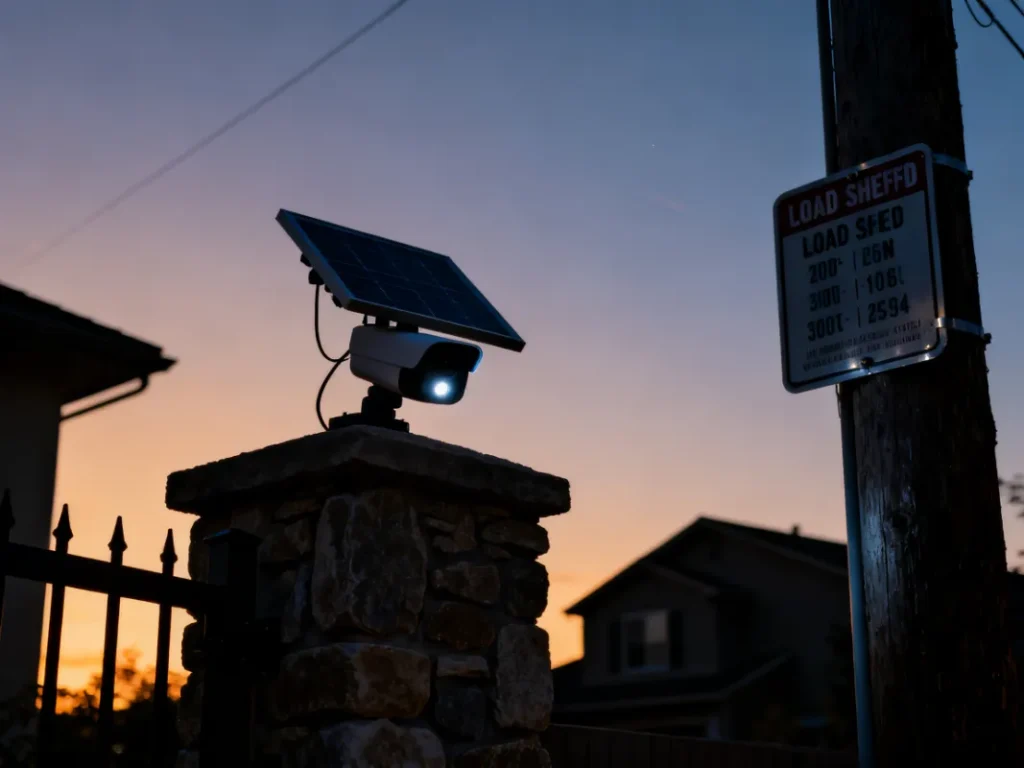
Solar cameras don’t care about Eskom’s schedule. They’ve got their own power supply and keep recording whether the grid is up or not. If you’re in an area that gets Stage 4–6 regularly, this alone is reason enough to consider switching. Pair a solar camera with a mobile data SIM and your security system runs completely off-grid.
Solar Camera vs Traditional CCTV: Side-by-Side Comparison
Here’s the full picture at a glance so you can see exactly where each system wins and loses:
| Feature | Solar Camera | Traditional CCTV |
| Power Source | Solar panel + battery | Mains electricity (Eskom) |
| Load Shedding Impact | ✅ None – fully independent | ❌ Goes offline without UPS/generator |
| Installation | ✅ No cables, DIY-friendly | ❌ Cabling required, often needs an installer |
| Upfront Cost (ZAR) | R800 – R3,500 per camera | R1,500 – R8,000+ (incl. installation) |
| Monthly Running Cost | ✅ R0 (no electricity drawn) | ⚠️ Adds to your Eskom bill |
| Night Vision | ✅ Yes (IR or colour) | ✅ Yes (IR or colour) |
| Remote Viewing | ✅ Yes (WiFi / 4G) | ✅ Yes (WiFi / NVR) |
| Placement Flexibility | ✅ Anywhere with sunlight | ❌ Limited by cable runs |
| Video Storage | SD card / cloud | DVR/NVR or cloud |
| Best For | Load shedding areas, farms, gates | Urban homes with stable Eskom supply |
The takeaway: If you’ve got reliable Eskom power and a professional installation budget, traditional CCTV still holds its own. But for most South African homes dealing with load shedding, solar cameras are now the practical default.
Which System Is Easier and Cheaper to Install?
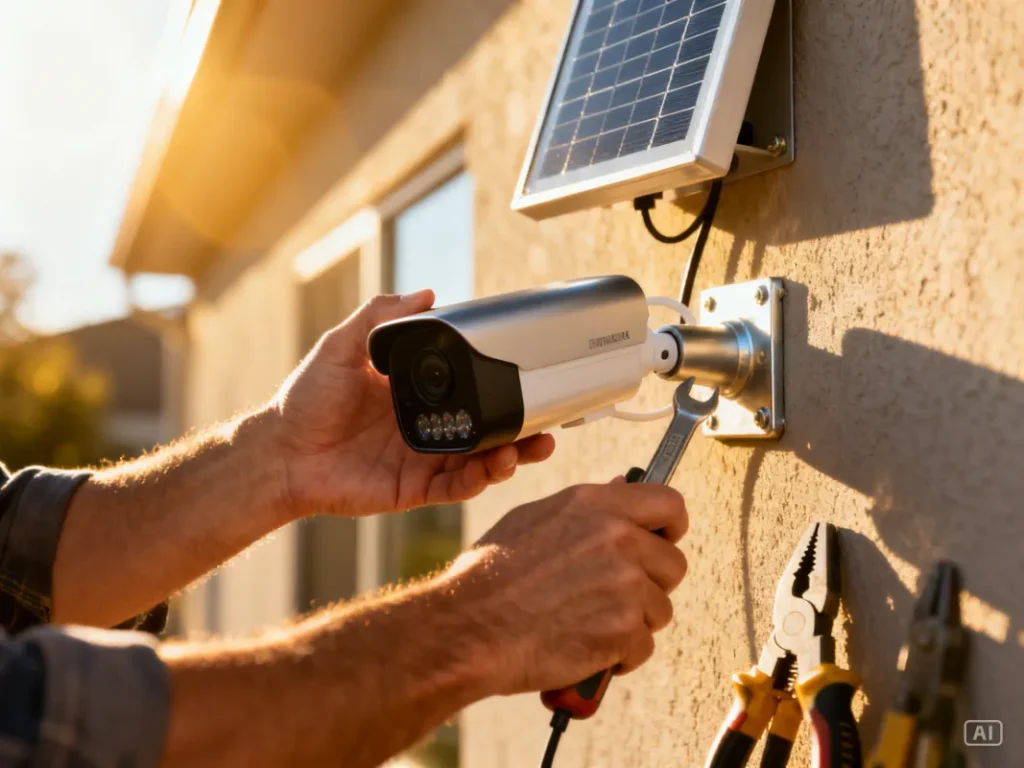
Solar cameras win this one by a mile. There’s no cabling, no drilling through walls for conduit, and no need to hire an electrician or CCTV installer. You mount the bracket, point the panel at the sun, and connect it to your WiFi. Most people are done in under an hour.
Traditional CCTV requires running cables — often through ceilings and walls — to connect each camera to a DVR or NVR unit. In a typical South African home, professional installation can cost R2,000–R5,000 on top of the equipment. If you’re renting, that’s a non-starter. Solar cameras are a renter’s best friend because they leave no permanent marks.
How to Decide Which System Is Right for Your Home
Ask yourself these questions and the answer will become clear:
- How often does your area get load shedding? If it’s Stage 3 or higher more than twice a week, solar is the safe bet. Traditional CCTV will leave you blind for hours at a time.
- Do you own or rent? Renters should almost always go solar — no permanent cabling, easy to take with you when you move.
- How many cameras do you need? Traditional CCTV makes more sense for a large property with 8+ cameras feeding into a single DVR. For 1–4 cameras on a standard home, solar is simpler and usually cheaper all-in.
- Is your WiFi stable? Solar cameras transmit wirelessly, so your router needs to reach the coverage area. If your WiFi is weak at the gate or back wall, get a WiFi extender or look for a solar camera with a 4G SIM slot.
- What’s your total budget? Add up the camera cost, installation, DVR, cables, and potential UPS for traditional CCTV. Most people are surprised to find solar cameras are cheaper all-in, not just upfront.
Is the Video Quality Actually Comparable?
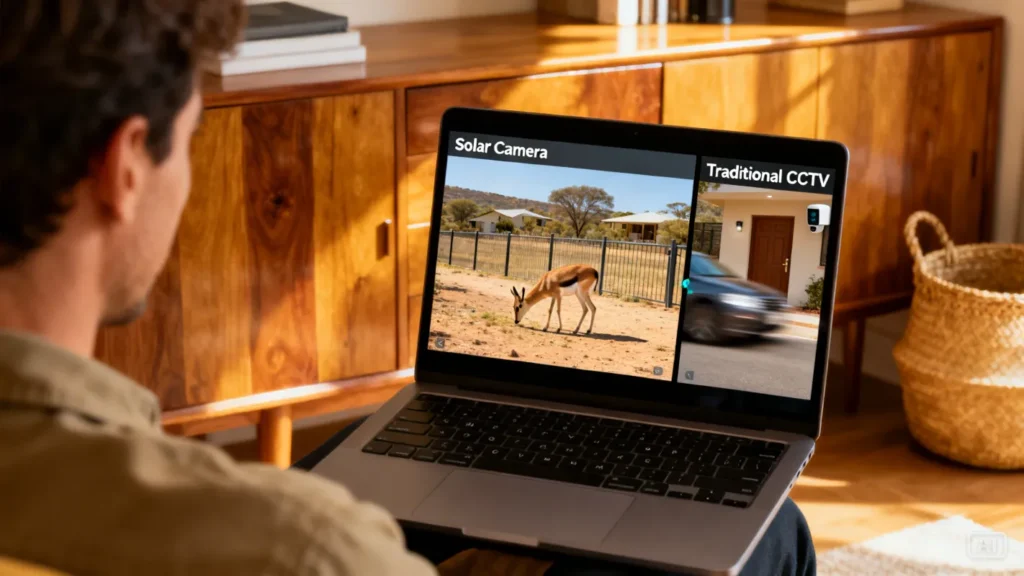
Yes — modern solar cameras are on par with traditional CCTV for most home security needs. Entry-level solar cameras now shoot at 1080p Full HD, and higher-end models go up to 2K and 4K. Night vision is handled through infrared (IR) LEDs or colour night vision, both of which are common across solar and wired options.
Where traditional CCTV still has an edge is in systems with local DVR storage. A 4-camera wired CCTV setup with a 1TB DVR gives you weeks of continuous recording without relying on cloud storage or SD cards. Solar cameras typically record motion-triggered clips to an SD card or the cloud. For most home users, this is more than adequate — you’re not rewatching 3-week-old footage anyway.
Mini UPS for WiFi Routers Explained
What Zacks Bargains Recommends for South African Homes
For the overwhelming majority of South African households — especially those in load shedding-heavy areas — a solar WiFi camera is the smarter, more practical choice right now. It’s self-powered, easy to install, costs less all-in, and doesn’t go offline every time Eskom decides to take a break.
If you’re on a farm, in a remote area, or want gate and perimeter monitoring without worrying about running cables hundreds of metres, solar is your only sensible option. If you’re managing a large business premises or a complex with 10+ cameras, a professional wired CCTV system with backup power is worth the investment.
For most homes, the Ultimate Guide to Solar Security Cameras in South Africa covers everything you need to choose the right model and set it up properly.
Zack’s Verdict
If your electricity goes off more than twice a week, you cannot trust a wired CCTV system to protect your home. It’s a R5,000 camera system that becomes completely useless during the exact hours criminals operate. Solar cameras aren’t perfect — their SD cards fill up, WiFi range is a limitation, and you need decent sunlight for sustained battery life. But they work when the power’s out, they’re dead easy to install, and the price has dropped to the point where there’s no longer a big cost premium to justify.
Traditional CCTV still makes sense for large properties with professional setups and reliable backup power. For the average South African homeowner? Go solar. You’ll be glad you did the first time Stage 4 hits at 2am.
Frequently Asked Questions
Do solar cameras work during load shedding?
Yes — this is their biggest advantage over traditional CCTV. Solar cameras charge during daylight hours and store power in a built-in battery. They continue recording throughout load shedding with no interruption, typically for 2–5 days on a full charge.
Are solar cameras as good as traditional CCTV?
For most home security needs, yes. Modern solar cameras shoot at 1080p to 4K, include motion detection and night vision, and offer remote viewing via app. Where wired CCTV still has an edge is in large multi-camera setups with continuous DVR recording.
How much does a solar security camera cost in South Africa?
Expect to pay between R800 and R3,500 for a quality solar camera, depending on resolution, battery size, and whether it includes a SIM card slot. That’s often cheaper all-in than a wired camera once you factor in installation and cabling costs.
Do I need WiFi for a solar camera?
Most solar cameras use WiFi to send alerts and allow remote viewing. If your WiFi doesn’t reach the camera location, you can either use a WiFi range extender or choose a solar camera with a 4G SIM card slot for fully independent connectivity.
Can I install a solar camera myself?
Absolutely — that’s one of the main benefits. Most solar cameras come with a mounting bracket and basic hardware. You mount it, aim the solar panel at the sun, connect it to your WiFi via the app, and you’re done. No electrician required.
Which is better for a farm or rural property — solar or wired?
Solar, without question. Running cables hundreds of metres across a farm is expensive and impractical. Solar cameras can be mounted anywhere with sunlight and connected via 4G SIM, making them purpose-built for rural South African properties.
Does load shedding affect traditional CCTV?
Yes, significantly. Traditional CCTV systems run on mains power and go offline during load shedding unless you’ve installed a UPS (uninterruptible power supply) or a generator. Adding a UPS adds cost and complexity to what’s already a more expensive system.
What happens to solar camera footage during load shedding?
Nothing — recording continues normally. The camera runs off its internal battery and stores footage to an SD card or cloud service. As long as your WiFi router has backup power (or the camera uses 4G), you’ll receive motion alerts on your phone throughout the outage.
Ready to Make the Switch?
Head over to Zacks Bargains to check out our range of solar security cameras tested and rated for South African conditions. Whether you need a single gate camera or coverage for your whole property, we’ve got practical options at prices that make sense. Don’t let the next Stage 6 catch you with a blank screen.
The truth is, load shedding has changed the home security game in South Africa permanently. A camera that goes offline every time Eskom flips the switch isn’t actually securing your home — it’s giving you a false sense of security. Solar cameras have matured to the point where they match traditional CCTV on video quality, beat it on installation simplicity, and laugh at load shedding.