Solar camera for warehouse security: Keeping Your Stock Safe During Load Shedding
Running a storage facility or distribution centre in South Africa is stressful enough without constantly worrying about the power cutting out. When Stage 4 hits and your traditional CCTV system dies, your inventory becomes an easy target for syndicates and opportunistic chancers. A solar camera for warehouse security solves this massive vulnerability instantly and completely. These standalone units run entirely on their own lithium batteries and solar panels, meaning they keep a watchful eye on your yard even when Eskom leaves the entire industrial park in the dark. You get reliable, 24/7 surveillance without laying a single trench through your concrete yard or paying an electrician for days of labour.
Why a solar camera for warehouse security beats traditional CCTV
A solar camera for warehouse security outperforms traditional wired systems because it operates completely independent of the national grid. It relies on a built-in battery and a dedicated solar panel to stay powered, ensuring your recording never stops during sudden blackouts. Traditional CCTV requires expensive UPS backups or thirsty diesel generators just to keep the main DVR running.
If you are managing a large industrial space, running cables across a massive yard to the perimeter fence costs an absolute fortune in materials and labour. With an off-grid setup, you literally just mount the unit to a pole or the corrugated siding, connect it to your WiFi or insert a data SIM, and you are live. This saves you thousands of Rands in installation fees alone, making it a much smarter investment for your business bottom line. You can also easily unbolt it and move it if your high-risk stock is relocated to a different receiving bay.
Key features to look for in industrial solar setups
The most critical features for industrial use are a massive battery capacity, dual-lens capabilities for wide coverage, and active deterrence like sirens or strobe lights. You need a system that can comfortably survive 12 hours of severe load shedding while actively scaring off intruders, not just quietly recording them stealing your pallets.
Do not waste your time with cheap, entry-level plastic units if you are protecting high-value commercial stock. Look for heavy-duty models with an IP66 or IP67 weather rating to handle our harsh summer thunderstorms and the thick dust of industrial zones like Isando or the East Rand. You also want strong infrared night vision that can clearly identify a vehicle number plate at the main gate from 20 metres away in pitch darkness. The stronger the night vision, the better your chances of handing useful evidence over to the SAPS.
Step-by-step: Installing a solar camera for warehouse security
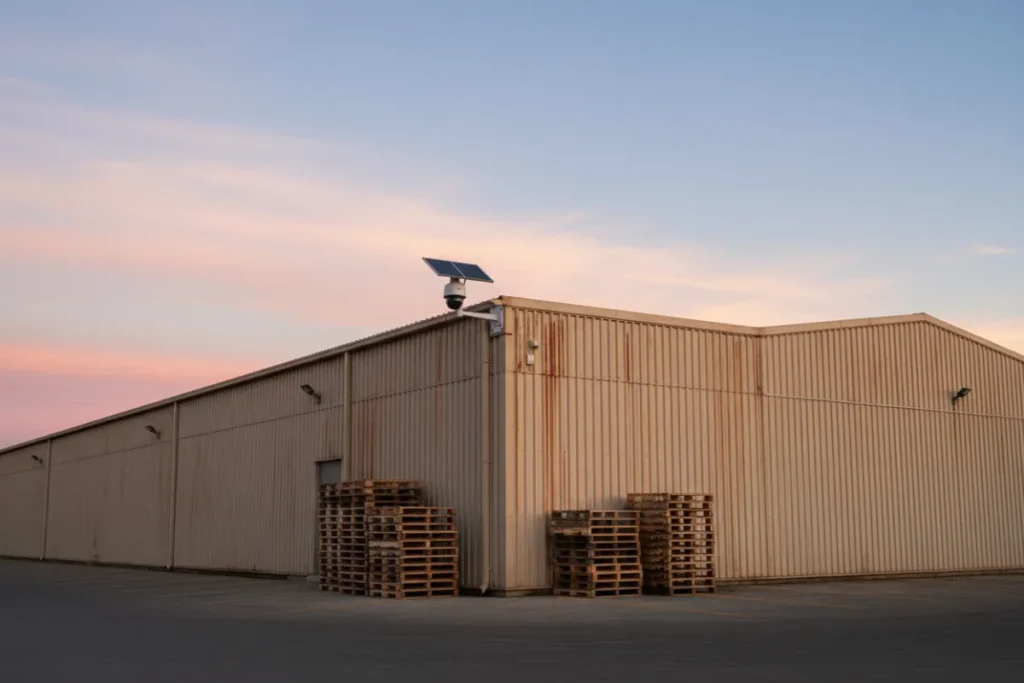
Installing a solar camera for warehouse security is surprisingly simple and usually takes a standard maintenance team less than an hour per unit. You just need to secure the heavy-duty mounting bracket, position the solar panel for maximum sun exposure, and pair the device with your smartphone or control room tablet.
Follow these straightforward steps to get your perimeter secured before the night shift starts:
- Identify the blind spots: Walk your perimeter and find the high-risk zones, like the back boundary wall or the dispatch roller doors.
- Check the sun angle: Ensure the spot you choose gets at least 4 to 6 hours of direct sunlight daily, facing the panel north if possible.
- Mount the bracket: Use heavy-duty masonry anchors to fix the bracket high enough (about 3.5 to 4 metres) so it cannot be easily tampered with or accidentally hit by a passing forklift.
- Connect and angle: Attach the camera housing, plug the solar panel cable into the waterproof port, and angle the lens to cover the entry choke point perfectly.
- Sync the app: Scan the QR code, connect to the warehouse Wi-Fi or 4G network, and set your motion detection zones so stray animals don’t trigger the main alarm.
Comparison: Solar vs Wired Warehouse Security
The biggest difference between these two options comes down to installation complexity and load shedding resilience. Solar systems offer immediate, off-grid protection with zero cabling, while wired systems offer continuous indoor recording but fail instantly during power cuts unless heavily backed up.
Here is how they stack up for a typical South African industrial site:
| Feature | Solar Camera Setup | Traditional Wired CCTV |
| Load Shedding Proof | Yes, runs on internal battery | No, requires heavy UPS/Generator |
| Installation Cost | Very low (DIY or basic maintenance) | Very high (Trenching, cabling, electrician) |
| Running Costs | Zero (Powered by the sun) | High (Grid electricity, generator fuel) |
| Relocation | Easy to move to new weak points | Permanent, requires re-wiring |
| Best Application | Perimeters, yards, remote gates | Indoors, near the main office/DVR |
Recommended placements for maximum coverage
To get the most out of your off-grid system, place your cameras at major choke points like the main entrance gate, the receiving bays, and the darkest corners of your perimeter fence. You want to capture clear footage of absolutely every vehicle and person entering or leaving the premises.
A highly effective strategy is to mix your technology to suit the environment perfectly. Use your existing wired cameras indoors where the power is relatively stable and the DVR is securely locked away. Then, deploy standalone off-grid units along the boundary walls where trenching through concrete would cost an absolute fortune.
If you need a solid recommendation for the exterior yard, check out a 4K Solar Camera for crystal-clear number plate recognition, or a Solar WiFi Security Camera for general wide-angle monitoring. To truly understand how these standalone units integrate into a broader commercial security strategy, make sure to read through our Ultimate Guide to Solar Security Cameras in South Africa to see how different local businesses are adapting.
Zack’s Verdict
Relying on the national grid to protect your warehouse inventory is a massive gamble that you will eventually lose. A dedicated solar setup fixes the absolute weakest link in your security chain instantly, giving you eyes on your stock even when the rest of the industrial park is pitch black.
I have seen business owners lose hundreds of thousands of Rands in copper, tools, and stock simply because their DVR tripped during a scheduled blackout. Do not wait for a devastating break-in to realize your current system has a massive, Eskom-sized blind spot. Grab a few heavy-duty solar units, mount them on your perimeter this week, and lock down your commercial yard for good.
Frequently Asked Questions
We get a lot of questions from business owners trying to secure their commercial properties without blowing their entire annual budget. Here are the straight, no-nonsense answers to the most common queries about industrial off-grid surveillance.
- Does a solar camera work during a week of heavy rain?Yes, high-quality models have large lithium batteries designed to power the unit for several days. Even with heavy cloud cover reducing the charging efficiency, the camera will keep running.
- Can multiple managers access the camera feed?Absolutely, the app allows you to share device access securely. You can authorize the warehouse manager, the night-shift security guard, and the business owner to view the live feed simultaneously.
- Do these cameras need a Wi-Fi connection to record?No, they will always record locally to their internal SD card whenever motion is triggered. However, you do need Wi-Fi or a 4G SIM card if you want to receive instant push notifications to your phone.
- How do we prevent the cameras from being stolen?Always mount them at least 3.5 metres high, completely out of easy reach. Many industrial models also feature anti-tamper alarms that sound a piercing siren if someone tries to rip them off the wall.
- Will the motion sensor be triggered by forklifts driving past?You can easily customize the motion detection zones and sensitivity inside the app. You simply draw a digital box around the actual boundary fence and tell the camera to ignore the active driveway.
- Can we link these to an armed response company?While they do not hardwire into traditional alarm panels, the technology is adapting fast. Many modern security companies can now integrate the camera’s app alerts directly into their control room monitoring software.
Conclusion
Securing an industrial property doesn’t require laying kilometers of cable or buying massive diesel generators anymore. By switching to off-grid surveillance, you eliminate the Eskom vulnerability completely and keep your inventory safe 24/7.
It is a practical, highly cost-effective move that pays for itself the very first time it prevents a theft during Stage 6. Head over to Zacks Bargains to browse our range of heavy-duty, weather-proof security solutions designed specifically for tough South African conditions. Secure your yard today and stop stressing about what happens when the lights go out.