Solar Camera for Gate Monitoring: See Every Entry Point — Even During Load Shedding
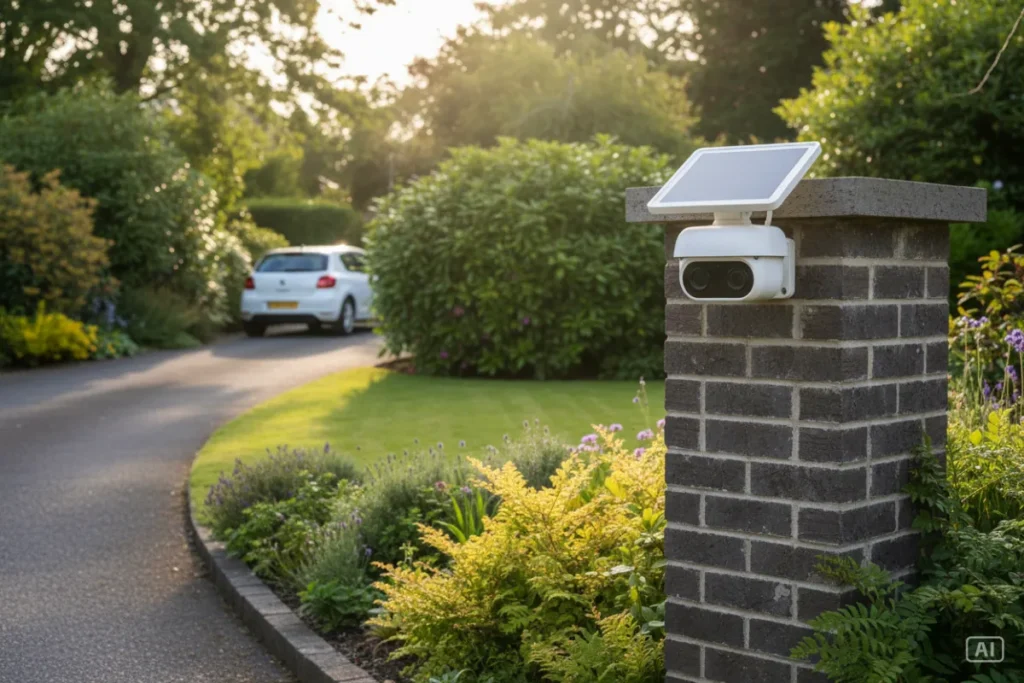
Your gate is your first line of defence. It’s the one choke point every visitor, delivery driver, and potential intruder has to pass through — and if you’re not watching it, you’re flying blind. A solar camera for gate monitoring fixes that problem permanently, without trenching cables across your driveway or worrying about Eskom cutting your feed at 6pm.
Most South African homeowners and small business owners either have no camera at their gate, or they have a wired one that goes dark the moment load shedding kicks in. Neither situation is acceptable when crime stats are what they are. Solar-powered gate cameras run off a charged battery all night and recharge during the day — so your entrance is covered around the clock, Stage 6 or not.
Why a Solar Camera for Gate Monitoring Outperforms Wired Options
A solar camera for gate monitoring doesn’t need a power outlet, a cable run, or an electrician. That’s the core advantage — but it goes further than just convenience. Wired cameras at gates are vulnerable: cut the power, and the camera dies. Solar cameras with onboard battery storage keep recording even if someone tampers with your mains supply.
The other practical win is placement flexibility. Gates are often far from the house, and running cabling 15–30 metres across a garden or driveway is expensive and disruptive. A solar unit mounts directly on the gate pillar or wall with four screws and starts working the same day. For a rental property, a smallholding, or a house where cabling just isn’t practical, it’s the only sensible option.
What Features Matter Most for Gate Camera Use
Gate monitoring has specific demands that not every solar camera is built for. Here’s what to prioritise:
- Wide field of view (100°–130°) — Your gate camera needs to capture faces, vehicles, and the full entrance width in one frame.
- Colour night vision — Standard infrared shows silhouettes. Colour night vision (using a built-in spotlight) lets you identify clothing, skin tone, and vehicle colour after dark.
- Vehicle detection — Better motion detection algorithms separate a person walking from a car pulling up. Fewer false alarms, more useful alerts.
- Two-way audio — Speak to visitors or delivery drivers directly through the camera app without going outside. Essential for security and convenience.
- High resolution (2K or 4K) — You need to read a number plate at 5–8 metres. 1080p struggles with this. 2K is the minimum for gate use.
- Large battery (15,000mAh+) — Gates are often in full sun during the day, which helps, but you need enough reserve for a long load shedding window overnight.
- IP66 or IP67 weatherproofing — Gate cameras are fully exposed to rain, wind, and dust. Don’t cut corners here.
Solar Camera vs Wired Gate Camera — Head-to-Head Comparison
| Feature | Solar Gate Camera | Wired Gate Camera |
|---|---|---|
| Works during load shedding | ✅ Yes (battery backup) | ❌ No (unless UPS fitted) |
| Installation | DIY — 30 minutes | Electrician + cabling required |
| Cable run across driveway | ❌ Not needed | ✅ Required (costly) |
| Placement flexibility | ✅ Mount anywhere with sun | ❌ Limited by cable route |
| Remote viewing via app | ✅ Yes | ✅ Yes (with setup) |
| Colour night vision available | ✅ Yes (mid-range+) | ✅ Yes |
| Upfront cost | R1,000–R2,500 | R3,500–R10,000+ installed |
| Ongoing maintenance | Minimal | DVR + cabling upkeep |
For most South African homes and small businesses, the solar option wins on every practical point. The only scenario where wired makes more sense is if you already have an existing CCTV system and are just adding a camera to it.
How to Set Up a Solar Camera for Gate Monitoring (Step-by-Step)
This is a genuine DIY job. You don’t need an electrician, and most people get it done in under an hour.
- Pick your mounting position — The gate pillar is the most common spot. Aim for 2.5–3 metres height, angled slightly downward to capture faces and plates at the entrance.
- Check sun exposure — The solar panel needs 4–6 hours of direct sun daily. Avoid positions permanently shaded by trees or walls. South-facing is ideal in SA.
- Pre-charge the battery — Before mounting, charge the unit fully via USB. Don’t rely on day-one solar alone.
- Drill and mount the bracket — Use rawl bolts for brick pillars. Check the angle captures both sides of your gate opening before tightening completely.
- Connect to the app — Download the manufacturer’s app (Reolink, Ezviz, Annke, or Tuya depending on your brand) and follow the Wi-Fi pairing steps.
- Set motion detection zones — Draw your detection zone to cover your gate and entrance only. Exclude the pavement or road to avoid constant alerts from passing traffic.
- Configure vehicle detection — If your camera supports it, enable vehicle-specific alerts separately from person detection.
- Insert and format your SD card — Format it inside the app and set to loop recording. This way old footage is overwritten automatically once the card is full.
- Test day and night — Check your live feed in daylight, then again after dark to confirm night vision range and quality cover your full entrance.
Best Mounting Positions for Gate Camera Coverage
Placement determines whether your camera is genuinely useful or just a deterrent sticker with a lens. Here are the positions that work best for gate monitoring:
On the gate pillar (most common): Mounted at 2.5–3 metres on the latch-side pillar, angled inward. This captures faces of people approaching the gate and the front of vehicles entering. It’s also the most visible position, which adds deterrence value.
On the wall beside the gate: If your pillar doesn’t offer good sun exposure, the adjacent boundary wall is often a better solar option. You get the same angle with potentially better panel orientation.
Above the intercom or buzzer: If you have an intercom system, mounting directly above it captures every visitor at close range — ideal for face identification. Pair it with a second camera covering the wider driveway for full coverage.
On the inside of the property facing outward: This covers vehicles leaving as well as entering, and is harder to reach or vandalize from outside the property. Useful for smallholdings and business entrances where vehicle tracking matters.
For a full breakdown of camera options and placement strategies, check out the Ultimate Guide to Solar Security Cameras in South Africa.
How Much Should You Pay for a Solar Gate Camera in South Africa?
Prices have come down significantly in the last two years. Here’s a realistic breakdown of what you get at each price point:
- R900–R1,400: 1080p resolution, basic IR night vision, motion alerts, SD card storage. Works fine for a secondary gate or low-risk entrance. Not ideal as your only gate camera if number plate reading matters.
- R1,400–R2,000: 2K resolution, colour night vision, two-way audio, vehicle detection. This is the sweet spot for most South African gates. Covers faces and plates well after dark.
- R2,000–R3,000+: 4K, dual solar panels, extended battery, advanced AI detection. Worth it for business entrances, large properties, or anyone who needs forensic-quality footage.
Don’t go below 2K resolution if plate reading is a priority. One good camera at R1,600 beats two blurry ones at R800 every time.
Zack’s Verdict
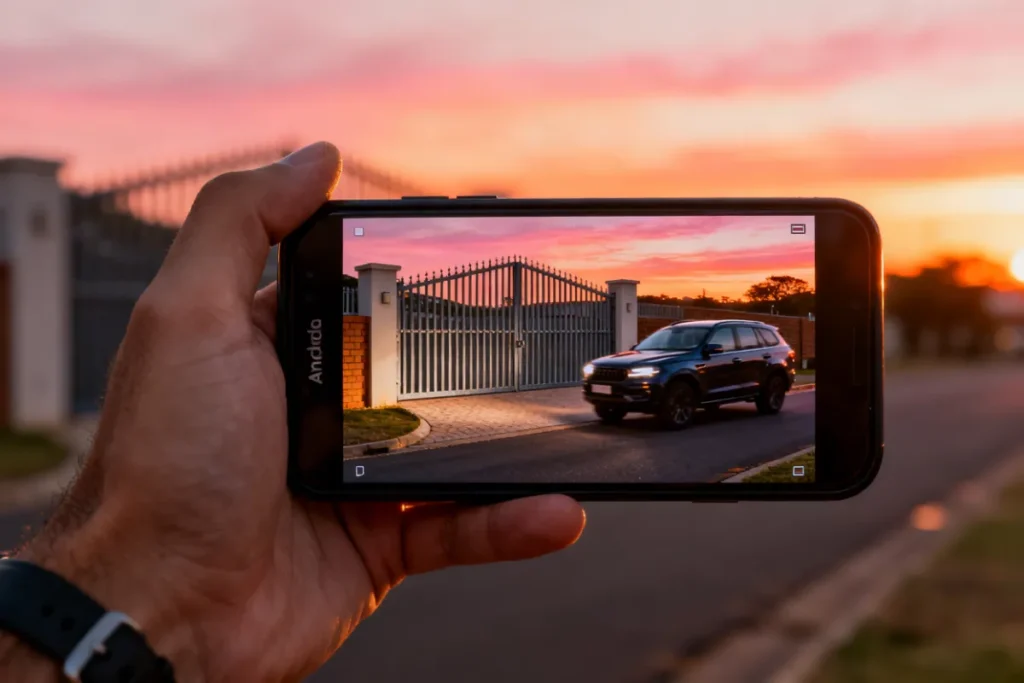
Your gate is where security either works or it doesn’t — and a camera that goes dark during load shedding isn’t a security camera, it’s a prop. A proper solar camera for gate monitoring costs between R1,400 and R2,000, takes less than an hour to mount yourself, and gives you live footage plus motion alerts on your phone 24 hours a day. If you’re going to spend money on one camera for your property, this is the one. Start at the gate. Everything else comes after.
Frequently Asked Questions
Q: Can a solar camera for gate monitoring read number plates at night? Yes, but you need at least 2K resolution with colour night vision or a dedicated IR spotlight. Standard 1080p cameras with basic infrared will show a vehicle but often struggle to resolve plate text clearly beyond 4–5 metres. Invest in 2K minimum if plates matter to you.
Q: What happens to my gate camera during a 12-hour load shedding block? A solar camera with a 15,000mAh+ battery will run comfortably through 12 hours of darkness or load shedding. The battery charges during daylight hours and carries the camera through the night and any power cut window. As long as the panel gets adequate sun daily, you won’t have gaps in your footage.
Q: Do I need Wi-Fi at my gate for the camera to record? No. The camera records to the onboard SD card without Wi-Fi. You only need Wi-Fi (or a mobile data connection) for live viewing and push alerts on your phone. Some cameras support a 4G SIM card as an alternative if your gate is too far from your home router.
Q: How do I stop getting constant alerts from passing traffic on the road? Use the motion zone feature in the camera app to draw a detection boundary that covers only your gate and driveway. Exclude the pavement and road from the detection area entirely. Most 2K+ cameras also offer vehicle vs. person classification, which further reduces irrelevant notifications.
Q: Can I use a solar gate camera on a sliding gate or boom gate? Yes. The camera mounts on the fixed pillar or wall beside the gate — not on the moving gate itself. The gate mechanism doesn’t affect the camera at all.
Q: Is my solar camera at risk of being stolen off the pillar? Mount it at 2.5–3 metres using tamper-resistant screws, and choose a model with a tamper alert. At that height it’s not a casual grab. The visible presence of the camera is also a deterrent in itself — most opportunists will move on when they spot it.
Q: How often do I need to clean the solar panel? A quick wipe with a damp cloth every 4–6 weeks keeps the panel at full efficiency. Dust and bird droppings are the main culprits in SA conditions. It takes 30 seconds and makes a noticeable difference to charge performance.
Secure Your Gate. Secure Your Property.
Your gate is the most important camera position on your property — and it’s also the easiest to cover with a solar-powered unit. No cables, no electrician, no blind spots during load shedding. One well-placed solar camera for gate monitoring gives you eyes on every entry and exit, live on your phone, all day and all night.
Browse the full range of solar gate cameras at Zacks Bargains and find the right fit for your entrance, your budget, and your load shedding reality.