Solar Camera for Small Shops: The Affordable Security Fix That Works During Load Shedding
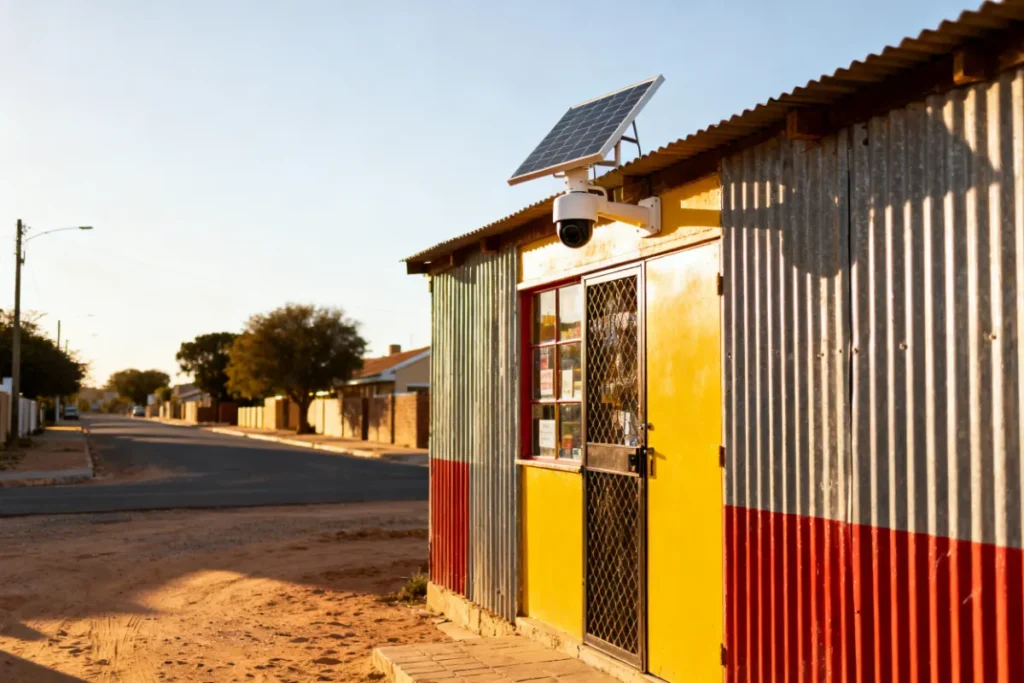
If you run a small shop in South Africa — a spaza, a hair salon, a hardware, a tuck shop — you already know the security stress. Break-ins happen fast, staff theft is real, and load shedding knocks out your traditional CCTV at exactly the wrong moment. A solar camera for small shops solves all three problems in one shot, and it doesn’t require an electrician, a big budget, or a monthly monitoring fee.
Most small shop owners think proper security is only for big retailers with big budgets. That’s not true anymore. Solar-powered cameras have come down dramatically in price, and the best ones are designed to keep running through 6–12 hours of load shedding without blinking. This article breaks down everything you need to know before you buy.
Why a Solar Camera for Small Shops Makes More Sense Than Traditional CCTV
A solar camera for small shops is a better fit than wired CCTV for one simple reason: it doesn’t depend on Eskom. Traditional CCTV systems need a DVR, a power supply, and constant electricity to record. The moment Stage 4 hits, your cameras go dark — and that’s exactly when opportunists are watching.
Solar cameras have a built-in panel that charges a battery throughout the day. That battery powers the camera through the night and through load shedding windows. There’s no DVR to maintain, no cable runs to pay for, and no electrician callout fee. For a small business operating on tight margins, that’s not a minor benefit — it’s the whole point.
What to Look For When Buying a Solar Security Camera for Your Shop
Not all solar cameras are equal. Here’s what actually matters for a small shop environment:
- Battery capacity — Look for at least 10,000–15,000mAh. This covers a 12-hour load shedding window comfortably.
- Resolution — 2K or 4K is worth it. You need to see faces and read number plates at the entrance, not just blurry shapes.
- Motion detection + alerts — Real-time push notifications to your phone mean you don’t need to watch a screen all day.
- Two-way audio — Some models let you speak through the camera. Useful for telling someone to move away from your stock.
- Local storage (SD card) — Don’t rely only on cloud storage. An SD card keeps footage even when your Wi-Fi drops.
- IP66 or IP67 rating — Your camera will face dust, rain, and heat. Anything below IP65 isn’t worth installing outside.
Solar Camera vs Wired CCTV for Small Shops — Side-by-Side Comparison
| Feature | Solar Camera | Wired CCTV |
|---|---|---|
| Works during load shedding | ✅ Yes (battery backup) | ❌ No (needs UPS or generator) |
| Installation cost | Low — DIY friendly | High — electrician required |
| Monthly fees | None (local SD storage) | Optional cloud fees |
| Portability | ✅ Move it if needed | ❌ Fixed, cabling involved |
| Remote viewing | ✅ App-based | ✅ App-based (with setup) |
| Upfront cost | R800–R2,500 | R3,000–R8,000+ (installed) |
| Maintenance | Minimal | DVR + wiring maintenance |
The cost difference alone makes solar the obvious starting point for a small shop owner. You can get a solid setup for under R2,000, installed by yourself on a Saturday morning.
How to Set Up a Solar Camera for Small Shops (Step-by-Step)
Setting this up yourself is genuinely straightforward. Here’s how to do it right:
- Choose your mounting position — Cover your entrance, till area, or stock room. Height of 2.5–3 metres gives the best angle without being easy to reach.
- Check sun exposure — The solar panel needs 4–6 hours of direct sunlight daily. South-facing walls work best in South Africa.
- Charge before installing — Plug the camera in via USB for a full charge before mounting. Don’t rely on the first day of sun.
- Mount the bracket — Use the supplied rawl bolts for brick walls. Make sure it’s level before tightening.
- Download the app — Most brands use a dedicated app (Ezviz, Reolink, Tuya). Connect to your shop’s Wi-Fi or mobile hotspot.
- Set motion zones — Define the detection area in the app so you only get alerts for your shop entrance, not passing pedestrians.
- Insert your SD card — Format it in the app before use. Set to loop recording so it overwrites old footage automatically.
- Test night vision — Check the feed after dark to confirm the infrared range covers your key areas.
The Best Placement Spots Inside and Outside Your Shop
Placement is half the battle. A well-positioned camera covers more ground and deters more effectively than three poorly placed ones.
Outside your shop:
- Above the main entrance (face height, inward angle)
- Above the back door or delivery entrance
- Covering the area where customers park or wait
Inside your shop:
- Pointed at the till and cash handling area
- Covering high-value stock shelves
- Aimed at the storeroom entrance
For most small shops, two cameras cover the full operation: one at the entrance and one at the till. That’s a total outlay of R1,600–R3,000 depending on the models you choose — a fraction of what one break-in costs you.
For a deeper look at the full range of options available, check out the Ultimate Guide to Solar Security Cameras in South Africa.
4K Solar Camera Solar WiFi Security Camera
How Much Does a Solar Camera for Small Shops Cost in South Africa?
You can get a reliable solar camera for small shops for between R800 and R2,500 depending on the features you need. Here’s a realistic breakdown:
- Entry-level (R800–R1,200): 1080p, basic motion detection, SD card storage, IP65 rating. Fine for a single entrance on a tight budget.
- Mid-range (R1,200–R1,800): 2K resolution, two-way audio, improved battery, better night vision. The sweet spot for most small shops.
- Premium (R1,800–R2,500+): 4K, colour night vision, dual solar panels, extended battery life. Worth it if you’re monitoring a larger space or high-value stock.
Don’t overspend on features you won’t use. For a spaza or small salon, a mid-range unit is all you need. Spend the saving on a second camera instead.
Zack’s Verdict
Look, if you’re still running a small shop with no cameras because “CCTV is too expensive,” that thinking is costing you more than a camera ever would. A decent solar camera for small shops runs R1,200–R1,800, works through load shedding, and takes less than an hour to set up yourself. There’s no subscription, no electrician, and no excuse. One prevented break-in pays for the whole system ten times over. Buy one camera this week, mount it at your entrance, and add a second one next month. Simple as that.
Frequently Asked Questions
Q: Does a solar camera for small shops work at night? Yes. All quality solar cameras include infrared (IR) night vision. Premium models offer colour night vision using a built-in spotlight. For indoor use or areas with some ambient light, standard IR is more than enough.
Q: What happens to the footage during load shedding? The camera keeps recording to the SD card using its internal battery. As long as the battery has charge (typically 10–16 hours depending on the model), the camera continues operating normally. You won’t miss anything.
Q: Do I need Wi-Fi for a solar camera to work? You need Wi-Fi for remote viewing and push notifications on your phone. The camera itself will still record to the SD card without Wi-Fi. Some models support 4G SIM cards as a Wi-Fi alternative — useful for shops in areas with weak broadband.
Q: Can one camera cover my whole shop? It depends on your shop size. A wide-angle lens (110°–130°) covers a decent area, but for most shops you’ll want at least two cameras: one at the entrance and one at the till or stock area.
Q: Is it safe to mount a solar camera outside in South African weather? Yes, as long as you buy one with an IP66 or IP67 rating. These are dustproof and waterproof enough to handle SA rain, heat, and coastal humidity without any issue.
Q: Will someone steal the camera itself? Mount it at 2.5–3 metres and use tamper-proof screws. At that height it’s not an easy grab. Some cameras also trigger an alarm or send you an alert if they detect tampering or if the angle is shifted.
Q: How long do the batteries last before needing replacement? Most solar camera batteries are rated for 3–5 years of regular use. As long as the solar panel is clean and getting adequate sun, the battery stays topped up and you won’t need to replace it during normal operation.
The Bottom Line on Solar Cameras for Small Shops
Small shop security doesn’t have to be complicated or expensive. A solar-powered camera gives you 24/7 coverage, load shedding protection, and remote monitoring from your phone — all without monthly fees or an electrician. It’s the most practical security upgrade a small business owner can make right now.
Head over to Zacks Bargains to see the current range of solar cameras suited for small shops and small businesses. All products ship across South Africa, and there are options to suit every budget.