Solar Camera for Farms: The No-Nonsense Security Guide for South African Farmers
Farm attacks, livestock theft, equipment stealing, and trespassing are realities that South African farmers deal with every single day. If you’ve been looking for a practical, affordable way to monitor your property without running cables across hundreds of metres of land or relying on Eskom to keep your security system alive, a solar camera for farms is the most sensible solution available right now. These cameras run entirely on solar power, connect to your phone, and can be positioned anywhere on your property — from the main gate to the furthest outbuilding — without a single metre of electrical cable. This guide covers everything you need to know before you buy.
Why a Solar Camera for Farms Makes More Sense Than Traditional CCTV
A solar camera for farms solves the two biggest problems with traditional CCTV in a rural setting: power and distance. Running electrical cable from your farmhouse to a gate 500 metres away is expensive, time-consuming, and creates a vulnerability — cut the cable, kill the camera. Solar cameras eliminate both problems entirely. Each unit is self-powered and self-contained, which means you can position them wherever the threat is, not wherever the power happens to be.
Traditional wired CCTV systems also go offline during load shedding unless you’ve invested in a generator or a large UPS system. On a farm, where load shedding can stretch to 6–8 hours a day in rural areas, that’s an enormous security gap. A solar camera keeps recording through every stage of load shedding, every power dip, and every Eskom failure — because it doesn’t use the grid at all.
What to Look for When Buying a Solar Camera for Farms
Not every solar camera is built for the demands of a South African farm environment. You need to check specific features before spending money, because a camera that works fine on a suburban boundary wall may fail quickly in a harsh farm setting.
Key features to prioritise:
- IP66 or IP67 weatherproofing — Farm environments are dusty, wet, and exposed. IP65 is the minimum; IP66 or IP67 is strongly recommended for open veld or coastal farm conditions.
- Long-range night vision — Farm threats happen at night. Look for cameras with IR night vision range of at least 15–20 metres, preferably 30 metres for open areas.
- Large battery capacity — Farm locations may have less consistent sun exposure than suburban walls. A larger battery (10,000mAh+) gives you a bigger buffer on cloudy days.
- SIM card support — Many farm areas have weak or no WiFi coverage. A camera with a 4G SIM card slot uses mobile data instead of WiFi, which is critical for remote gate and boundary monitoring.
- Motion detection with zone control — Farms have a lot of natural movement — animals, wind, vegetation. Zone-based motion detection lets you define exactly which areas trigger alerts, cutting out false notifications.
- Durable housing — Metal or reinforced housing resists tampering better than plastic. On a farm, your cameras may be more exposed and harder to check regularly.
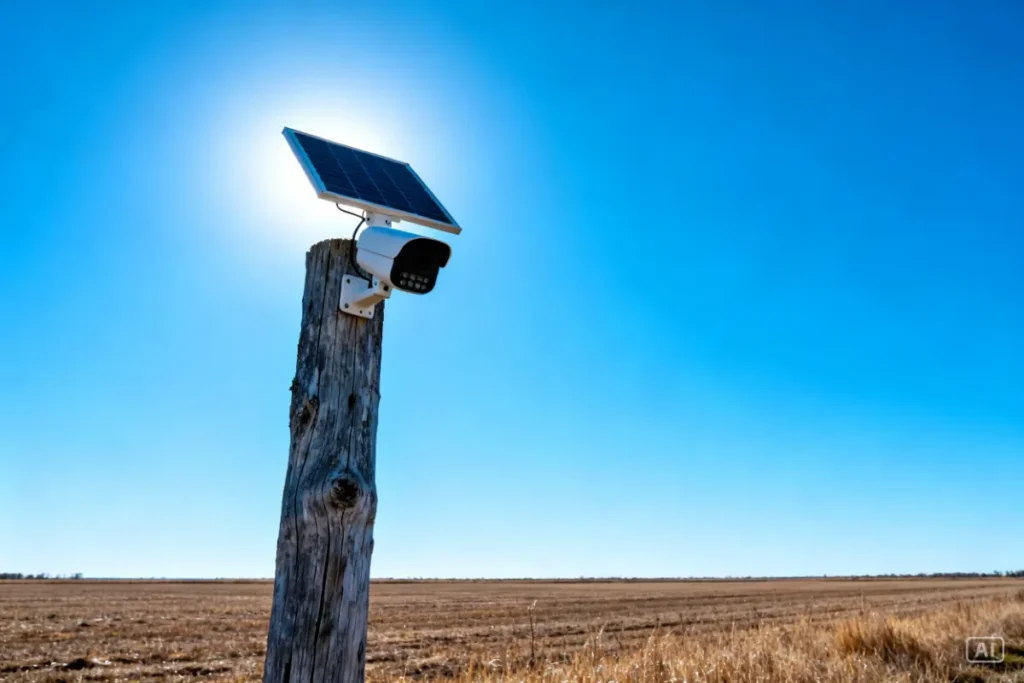
How to Position a Solar Camera for Farms Effectively
Placement on a farm is a completely different challenge compared to a suburban home. You’re covering large areas, multiple access points, and remote locations — often with no existing infrastructure to work with. Strategic positioning is the difference between a camera system that protects your farm and one that just records empty veld.
Priority locations for farm camera placement:
| Location | Why It Matters | Camera Spec Needed |
|---|---|---|
| Main farm gate | Primary access point for vehicles and people | Wide angle, plate capture, SIM card |
| Secondary gates and access roads | Often used by thieves to avoid main entrance | Motion detection, long battery |
| Livestock kraal or holding area | High-value target for theft | Night vision 20m+, motion alerts |
| Equipment storage and workshop | Tractors, generators, tools — all targets | Wide angle, local SD recording |
| Farmhouse perimeter | Personal safety and family security | Colour night vision, two-way audio |
| Water pump or irrigation infrastructure | Copper theft is rampant in SA | Remote location, SIM card support |
| Boundary fence lines | Early warning for trespassers | Long range, motion zone control |
Start with your main gate and livestock area — these are the highest-priority locations. Add cameras to secondary access points and equipment storage once your primary positions are covered. Don’t try to cover everything at once; a few well-positioned cameras are more effective than many poorly positioned ones.
Solar Camera for Farms: SIM Card vs WiFi — Which Do You Need?
This is the most important technical decision you’ll make when buying a solar camera for farms. Your answer depends entirely on your farm’s connectivity situation, so be honest about what you actually have.
WiFi solar cameras work well if your farm gate or outbuilding is within range of your farmhouse WiFi router — typically 30–50 metres in open conditions, less through walls and trees. If your cameras will be within this range, a standard WiFi solar camera is simpler to set up and cheaper to run.
4G SIM card solar cameras are essential for any location beyond WiFi range. These cameras use a standard SIM card (Vodacom, MTN, or Cell C work well in most rural areas) and send footage and alerts via mobile data. You pay for a small data SIM — usually R50–R150 per month per camera depending on your data plan and recording settings. For a gate 300 metres from your house or a camera on a remote boundary fence, a SIM card camera is the only practical option.
| Feature | WiFi Solar Camera | 4G SIM Card Solar Camera |
|---|---|---|
| Range from router | 30–50m (open air) | Unlimited (mobile coverage) |
| Monthly running cost | R0 (uses home WiFi) | R50–R150 data SIM |
| Setup complexity | Simple | Slightly more complex |
| Works in load shedding | Yes | Yes |
| Works without home internet | No | Yes |
| Best for | Near farmhouse locations | Remote gates, boundaries, kraals |
For farms in areas with good mobile coverage, the 4K Solar Camera with SIM card support gives you the best combination of image quality and remote connectivity.
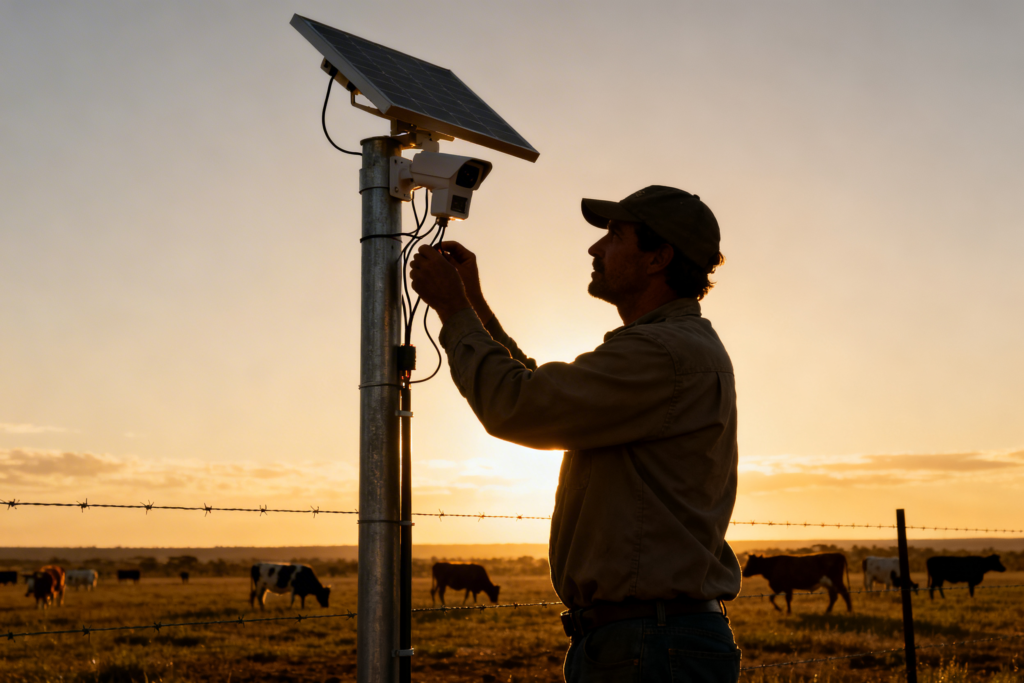
Step-by-Step: Setting Up a Solar Camera for Farms at a Remote Gate
Getting a SIM card solar camera running at a remote farm gate is straightforward if you follow these steps in order. This process assumes you’re using a 4G SIM camera at a location without WiFi.
Step 1 — Choose your SIM card and activate data Buy a prepaid SIM from Vodacom or MTN (best rural coverage in SA). Activate a data bundle — 1GB per month is sufficient for most single-camera setups on motion-triggered recording. Insert the SIM into the camera before powering it on.
Step 2 — Charge the battery before installation Leave the camera in direct sunlight for 6–8 hours before mounting. A full first charge ensures stable first-boot behaviour and gives you a full battery buffer from day one.
Step 3 — Download and set up the app Install the manufacturer’s app on your phone. Create your account and have it ready before you drive out to the gate. Trying to do this in a field with poor signal wastes time and frustration.
Step 4 — Mount the camera at the gate Position the camera at 2.5–3 metres height on the gate post, facing the approach road. Angle it slightly downward to capture faces and vehicle registration plates. Make sure the solar panel faces north for maximum sun exposure in South Africa.
Step 5 — Power on and pair via app Follow the in-app pairing instructions. With a SIM camera, pairing happens over mobile data rather than WiFi. Confirm you have mobile signal at the location before mounting — check your phone’s signal bars as a guide.
Step 6 — Configure motion detection zones Set your detection zone to cover the gate approach and entrance area. Exclude areas where animals, vegetation, or passing vehicles on public roads might trigger false alerts. Set sensitivity to medium as a starting point.
Step 7 — Test and confirm Walk through the gate and confirm you receive a motion alert on your phone. Check the live feed, night vision quality after dark, and confirm footage is saving to the SD card. Label the camera in your app so you know which gate or location it covers.
For more guidance on avoiding setup errors that affect performance, read our Solar Camera Installation Mistakes article before you mount anything.
Maintaining Your Farm Solar Camera System
Farm environments are harder on cameras than suburban settings — dust, humidity, animal interference, and UV exposure all take a toll. A basic maintenance routine keeps your cameras performing reliably year-round without needing professional help.
Monthly: Wipe the solar panel and camera lens with a damp cloth. Dust and grime accumulate fast in farm conditions, especially in the dry Highveld winter months. A dirty panel can reduce charging output by 20–30%, which directly shortens your overnight battery run time.
Every 3 months: Check all mounting brackets and screws for corrosion or loosening. Farm vibrations from machinery and wind exposure can work screws loose over time. Check the camera housing for signs of water ingress, insect nesting, or cracking. Update firmware through the app when available.
Annually: Test battery health by monitoring overnight discharge rates in the app. If the camera is dying significantly earlier than it used to, the battery may need replacement. Review your camera positions — threats change over time, and a camera that was ideally placed two years ago may need repositioning as your farm operations evolve.
The Ultimate Guide to Solar Security Cameras in South Africa covers long-term maintenance schedules and the best replacement parts to keep on hand for rural farm setups.
Zack’s Verdict
A solar camera for farms is one of the best security investments a South African farmer can make right now — and it’s not even close. You’re covering large areas, you’re dealing with load shedding, you’re often far from the nearest town, and you can’t afford to have your security system go dark at 2am because of Eskom. Solar cameras solve all of that without an electrician, without cable runs across your property, and without ongoing electricity costs. The SIM card models give you coverage anywhere on your farm regardless of WiFi range, and modern 4K sensors mean you’re getting number plate detail and facial recognition even on a budget. Don’t wait until something goes wrong on your farm to invest in this. Get your gate covered first, then add cameras to your livestock and equipment areas. Browse the full range at Solar WiFi Security Camera on Zacks Bargains and protect what you’ve built.
Frequently Asked Questions: Solar Camera for Farms
Q: Will a solar camera work in areas with frequent cloudy weather? Most solar cameras have enough battery capacity to run through 1–2 consecutive cloudy days without issue. If your farm is in a consistently overcast region — parts of the Eastern Cape or KwaZulu-Natal highlands — choose a model with a larger battery (10,000mAh+) and a higher-wattage solar panel (6W+) for better cloudy-day performance.
Q: How many cameras do I need for a typical South African farm? Start with your highest-risk locations: main gate, livestock kraal, and equipment storage. Three to five well-positioned cameras cover most small to medium farms effectively. Large commercial farms may need 8–15 cameras depending on the number of access points and outbuildings.
Q: Can animals trigger false motion alerts on farm cameras? Yes — livestock, dogs, and wildlife will trigger motion alerts if your detection zones aren’t configured correctly. Use the app to draw motion zones that exclude areas where animals roam freely, and reduce sensitivity slightly in high-animal-traffic areas. Some cameras also have human-only detection modes using AI — these cut false alerts significantly.
Q: What mobile network works best for SIM card cameras on SA farms? Vodacom has the strongest rural coverage across most of South Africa, followed by MTN. Check your farm’s signal strength on both networks before committing to a SIM — walk your camera locations with both network SIMs active and compare signal bars. Cell C and Telkom have improving rural coverage but are less reliable in remote areas.
Q: Is it safe to leave an expensive camera on a remote gate post? Choose cameras with anti-tamper alarms and sturdy metal housing for exposed locations. Mount them at 2.5–3 metres to make casual removal difficult. Some farms add a small metal security cage around remote cameras for additional protection. The deterrent value of a visible camera often outweighs the theft risk in most farm areas.
Q: Can I access my farm cameras from the city if I’m away? Yes — as long as the camera has mobile signal (SIM card model) or your farm’s internet is running (WiFi model), you can access live footage and motion alerts from anywhere in the world through the camera’s app. This remote monitoring capability is one of the biggest practical benefits for farmers who travel.
Q: How long does the battery last overnight on a fully charged solar camera? Most solar cameras with a standard 5,000–8,000mAh battery run for 24–72 hours on a full charge, depending on how frequently motion is triggered and whether night vision is active. A full day of South African sun is more than enough to recharge for the following night in most regions.
Conclusion
Farm security in South Africa is serious — and a solar camera for farms gives you a practical, affordable, load-shedding-proof way to protect your property, your livestock, and your family. Start with your gate and highest-risk areas, choose SIM card models for remote locations, and build your system out over time as your budget allows. Browse the full range of farm-ready solar security cameras at Zacks Bargains and take the first step toward securing your farm this week.