Essential Gadgets Every Home Needs During Load Shedding: The Ultimate Guide
When Eskom pushes the country into Stage 6, your house does not have to become a dark, disconnected cave. South Africans can no longer afford to wait around in the dark for the grid to stabilize, especially when working from home or trying to keep the kids entertained. Finding the Essential Gadgets Every Home Needs During Load Shedding is the smartest way to take control of your power situation without spending hundreds of thousands of Rands on a massive solar roof installation. By strategically investing in targeted backup gear, you can keep your lights on, your Wi-Fi running, and your screens powered up no matter what the schedule says.
Why a targeted load shedding survival kit South Africa is the smartest move
A targeted survival kit allows you to power only the specific devices you actually need during an outage, saving you a massive amount of money upfront. Instead of buying a R100,000 full-house inverter just to keep a TV and a router on, you can buy modular gadgets that handle those exact tasks efficiently.
This modular approach is incredibly flexible and practical for everyday living. If you rent a townhouse or an apartment, you cannot permanently install large solar panels or heavy lithium batteries into the property’s distribution board. Standalone gadgets can be moved from room to room, taken with you on holiday, or packed up easily if you ever move to a new house. It is about working smarter, not harder, to beat the blackout.
How to choose the best gadgets for power outages without wasting Rands
Choosing the right backup gear comes down to calculating exactly what you need to keep running and for how long. The biggest mistake people make is buying cheap, underpowered devices at the local supermarket that die after an hour of use.
You need to look closely at the battery capacity, usually measured in milliampere-hours (mAh) or Watt-hours (Wh), to ensure the device can survive a brutal four-hour blackout window. Always prioritize gadgets that use lithium-ion or LiFePO4 battery technology over old-school lead-acid batteries. Lithium batteries charge much faster when the power comes back on, they last for thousands of cycles, and they do not degrade quickly if you drain them completely.
Essential Gadgets Every Home Needs During Load Shedding for your internet
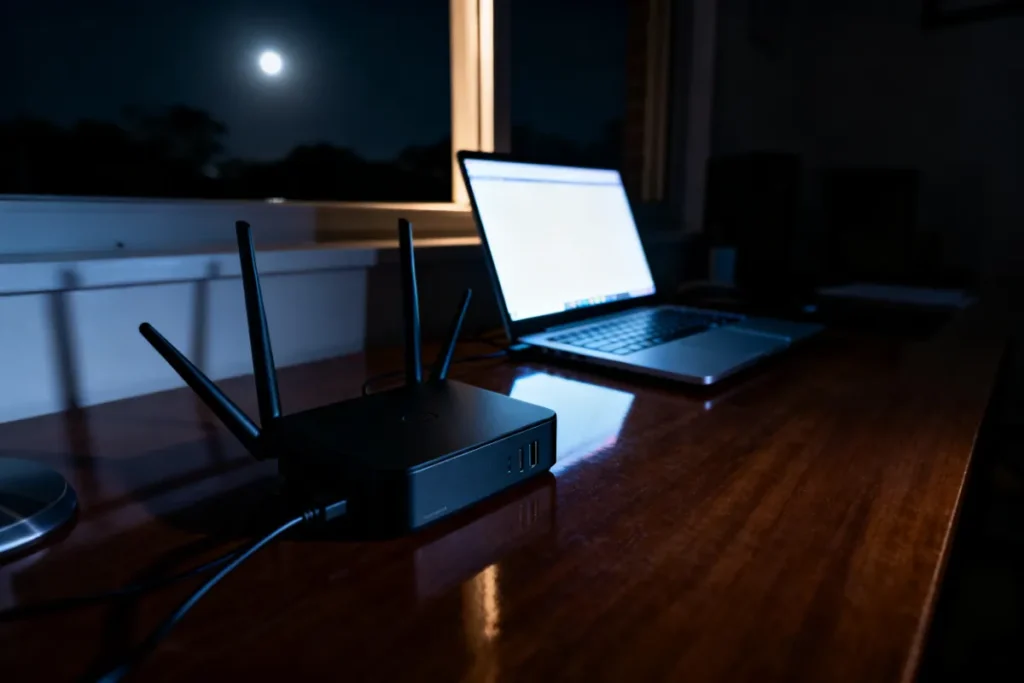
Keeping your fibre or LTE router online is the absolute most critical step for any modern South African household. A dedicated mini UPS for your router sits between your wall plug and the device, taking over instantly when the grid drops so your Zoom calls and Netflix streams never buffer.
You cannot just buy the first mini UPS you see; you must check the voltage requirements printed on the back of your specific router. Most standard fibre setups require either 5V, 9V, or 12V of power, and buying the wrong voltage will either fail to power the router or slowly damage the electronics. High-quality mini UPS units come with selectable voltage switches and multiple output cables, allowing you to power both your fibre ONT box and your main Wi-Fi router simultaneously for up to six hours.
Lighting your home with rechargeable emergency lights South Africa
Proper emergency lighting prevents accidents in the dark and keeps your home feeling normal and safe when the streetlights go out. The best strategy is to mix fixed rechargeable LED bulbs in your main ceiling fixtures with portable, magnetic LED strips for your kitchen and bathrooms.
Standard emergency LED bulbs are brilliant because they charge automatically while the light switch is turned on during normal power hours. When load shedding hits, they detect the drop in grid voltage and seamlessly switch to their internal battery, giving you up to four hours of bright light. For areas where you need focused light, like cooking over a gas stove, magnetic LED strips that stick directly to your extractor fan or fridge are an absolute lifesaver.
Emergency power backup solutions for keeping devices charged
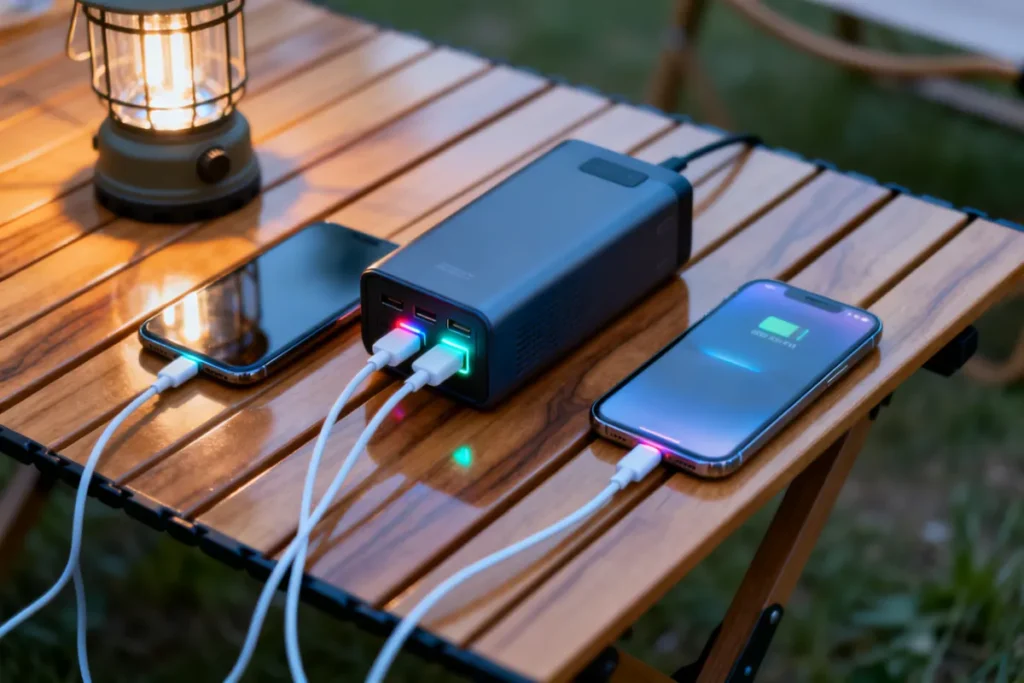
A dead smartphone during a blackout cuts you off from emergency services, family, and the load shedding schedule app. High-capacity power banks are non-negotiable survival tools that ensure your mobile devices stay topped up regardless of how long the grid is down.
For a family, a standard 5,000mAh power bank simply will not cut it during Stage 4 or Stage 6 schedules. You need to invest in rugged 20,000mAh or 30,000mAh units that can charge multiple phones, tablets, and rechargeable headlamps simultaneously. If you want to future-proof your setup, look for power banks that support fast charging (PD or QC 3.0) so you can rapidly refill the power bank itself during those short two-hour windows when the electricity returns.
Beating the summer heat: Why a rechargeable fan is critical
Surviving a power outage in the middle of a blazing South African January is miserable without proper airflow. A heavy-duty rechargeable fan keeps the air moving in your bedroom or lounge, making it entirely possible to sleep through a midnight blackout.
Modern rechargeable fans have evolved far beyond the weak, noisy plastic units of the past. Today, you can get oscillating floor fans with massive built-in batteries that run quietly for up to ten hours on a single charge. Many of the best models also include built-in LED nightlights and USB output ports, essentially turning your fan into a backup power bank for your phone in an absolute emergency.
Essential Gadgets Every Home Needs During Load Shedding for small appliances
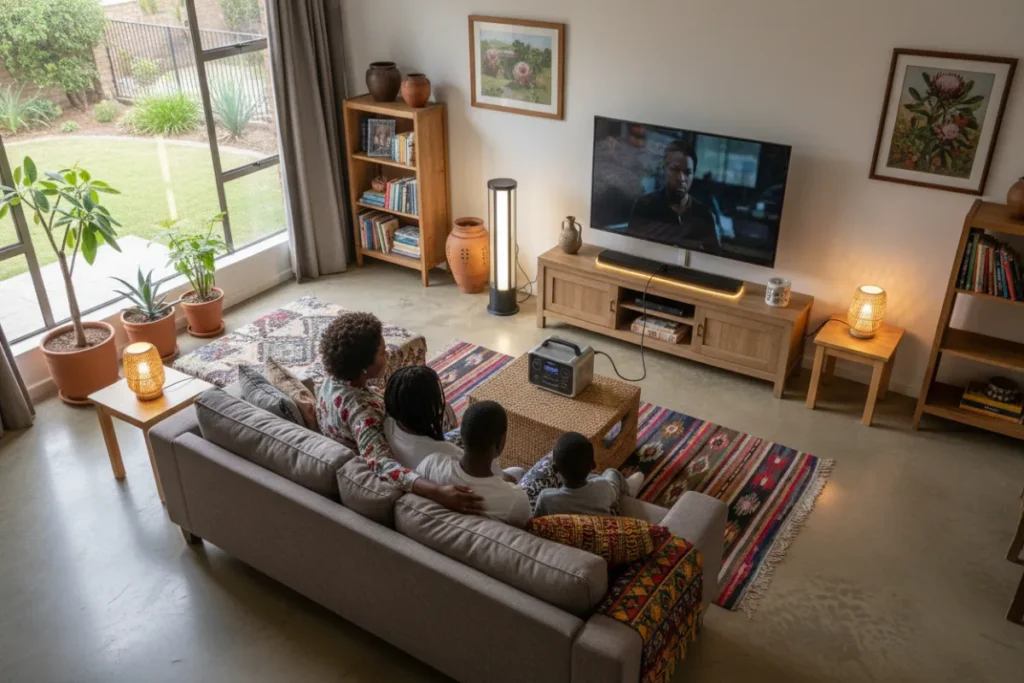
If you want to watch the rugby, run a laptop, or keep a small camping fridge cold, you need to step up from small power banks to a proper portable power station. These units are essentially massive lithium batteries wrapped in a neat box with standard South African 3-prong plug points built right in.
Entry-level power stations usually offer between 150W and 300W of output, which is perfect for running a flat-screen TV and a media box for a few hours. When shopping for one, it is absolutely vital to choose a model that features a “Pure Sine Wave” inverter rather than a “Modified Sine Wave.” Pure Sine Wave power is perfectly clean and identical to what comes out of your wall, ensuring that your sensitive TVs, laptops, and gaming consoles are not damaged by dirty power fluctuations.
Step-by-step: How to build your load shedding essentials for home
Building a reliable backup system does not have to be done all in one massive, expensive shopping trip. By following a structured plan, you can tackle your biggest pain points first and slowly build a completely off-grid ecosystem over a few months.
Follow this straightforward sequence to get your home secured efficiently:
- Audit your pain points: Sit down with your family and write down what actually frustrates you most during an outage (e.g., losing internet, dark kitchens, hot bedrooms).
- Secure the Wi-Fi first: Purchase a mini UPS specifically for your router and fibre box, as maintaining communication is always the highest priority.
- Fix the lighting: Replace the bulbs in your lounge, kitchen, and main bathroom with automatic rechargeable emergency LED bulbs.
- Buy personal power: Ensure every working adult or student in the house has their own 10,000mAh to 20,000mAh power bank for their personal devices.
- Save for the big ticket items: Once the basics are covered, put money aside for a portable power station to run your TV or a rechargeable fan for the summer months.
Comparing backup power devices for WiFi router against large inverters
Many homeowners get paralyzed trying to decide between buying a simple router UPS or saving up for a massive wall-mounted inverter. The truth is, these devices serve completely different purposes, and comparing them helps you understand where to put your money right now.
A mini UPS is a targeted, low-cost solution designed specifically for 12V or 9V electronics, while a full inverter system is meant to power 220V household appliances. If your only goal is keeping your laptops connected to the internet, spending R50,000 on an inverter is massive overkill.
| Feature | Mini Router UPS | Portable Power Station | Full Home Inverter |
| Primary Use | Wi-Fi Routers, Fibre boxes | TVs, Laptops, Fans | Entire DB board, Fridge, Lights |
| Average Cost | R500 – R1,000 | R3,000 – R8,000 | R50,000 – R150,000+ |
| Installation | Plug and play | Plug and play | Requires qualified electrician |
| Portability | Very high (pocket-sized) | High (can carry to any room) | None (bolted to the wall) |
| Output Type | DC (5V, 9V, 12V) | AC (220V standard plug) | AC (220V standard plug) |
Recommended load shedding survival gadgets for your home
To fully prepare your property for whatever schedule Eskom throws at us next, you need a combination of reliable, high-quality gear. Stacking these different solutions ensures that no matter what room you are in, you are covered.
To fully prepare your home, consider investing in these essential tools:
- A Mini UPS for WiFi routers to keep your internet running without dropping a single packet.
- High-Capacity Power Banks (10,000mAh – 30,000mAh) to keep your devices charged when the wall sockets are dead.
- Multiple Rechargeable LED lights for reliable, bright emergency lighting in your high-traffic rooms.
- Solar power banks and solar chargers for long-term power independence during extended grid failures.
- A Portable power stations for running small appliances like your television, laptop chargers, or a camping fridge.
- A heavy-duty Rechargeable fans to stay cool and comfortable during power cuts in the peak of summer.
Essential Gadgets Every Home Needs During Load Shedding
Zack’s Verdict
Trying to tough out load shedding with a few cheap candles and a dying cell phone is a miserable way to live. Getting your hands on the right survival gadgets completely shifts the dynamic from a stressful emergency to a minor inconvenience.
I have spoken to too many people who keep waiting for the government to fix the grid instead of taking action themselves. Do not wait for Stage 6 to hit before you rush to the shops to find empty shelves. Start small, buy a router UPS and a good power bank today, and gradually build up your arsenal. Spending a few Rands now buys you years of peace, comfort, and sanity in your own home.
Frequently Asked Questions
Navigating the world of backup power can be highly confusing with all the technical jargon and varying battery specs. Here are the most direct, practical answers to the questions we get asked every day.
- How long does a mini UPS keep a router running?A standard 10,000mAh mini UPS will typically keep a fibre ONT box and a standard Wi-Fi router running for 4 to 6 hours.
- Can I leave my rechargeable LED bulbs switched on all the time?Yes, they are designed to be used exactly like normal bulbs. They automatically manage their own charging cycle while the grid is on and only use the battery when the power drops.
- Is it safe to leave a power bank plugged in overnight?Modern, high-quality power banks have built-in overcharge protection circuits. Once they reach 100%, they stop drawing current, making them perfectly safe to leave plugged in.
- Can a portable power station run my fridge or microwave?Entry-level power stations (under 500W) cannot run heating elements or large compressors. You need a massive unit (1500W+) to safely start and run a large kitchen fridge or microwave.
- How long do the batteries in these gadgets last before degrading?Lithium-ion batteries typically last for 500 to 1,000 charge cycles, while newer LiFePO4 batteries can last over 3,000 cycles. With daily load shedding, expect a good lithium device to last 3 to 5 years.
- Do solar power banks actually work?Yes, but the small solar panel on the back charges the bank very slowly. They are excellent for hiking or extreme emergencies, but you should ideally charge them via a wall plug for daily load shedding use.
- What is the difference between a UPS and an inverter?A UPS switches to battery power instantly (in milliseconds) so devices like routers don’t reboot. An inverter has a slight delay when switching, which is fine for TVs but will drop your internet connection.
- Can I plug a multi-plug adapter into a portable power station?Yes, as long as the total combined wattage of all the devices plugged into the multi-plug does not exceed the maximum wattage rating of the power station.
Conclusion
Surviving the South African power crisis is no longer about lighting candles; it is about deploying the right technology to keep your life moving. By systematically investing in targeted backup gear, you ensure that your work, your entertainment, and your family’s comfort are never compromised by the grid.
Take stock of what you actually need, start with the most critical communication tools, and build your independence step-by-step. Head over to Zacks Bargains to explore our full range of tough, reliable, and affordable load shedding gadgets that have been tested to survive the absolute worst schedules Eskom can throw at us.