Choosing the Best Power Banks for Load Shedding to Keep Your Devices Alive
When Eskom cuts the power, watching your smartphone battery drop into the red is incredibly stressful. Finding the Best Power Banks for Load Shedding is no longer just a nice luxury; it is an absolute necessity for modern South African living. A dead phone means you are cut off from family, emergency services, work emails, and the load shedding schedule app itself. You do not need to sit in the dark watching your battery die slowly; you just need a reliable, high-capacity portable charger that actually delivers the power it promises on the box.
Why the Best Power Banks for Load Shedding are essential for daily survival
The Best Power Banks for Load Shedding provide immediate, portable energy that keeps your critical communication lines open when the wall sockets are dead. Unlike a noisy generator or a massive home inverter, these compact devices fit in your pocket and can be carried to the office, the braai, or the bedroom without any setup.
We rely on our phones and tablets for absolutely everything, from banking to entertaining the kids during a two-hour blackout slot. When you invest in a proper high capacity power bank SA model, you remove the anxiety of rushing to charge everything at the last minute before the grid drops. You simply plug in your cable, sit back, and carry on with your evening while your neighbours scramble in the dark.
What capacity do you need to charge phone during power outages?
To comfortably charge your smartphone multiple times during a severe outage, you need a power bank with a capacity of at least 10,000mAh, though 20,000mAh is highly recommended for Stage 6 schedules. Buying a cheap 2,000mAh promotional battery from the till point will only give your phone a slight top-up before dying completely.
A standard modern smartphone has a battery size of around 4,000mAh to 5,000mAh. A true portable charger 20000mAh model holds enough juice to recharge that phone fully about four times, which is easily enough to get a couple through a weekend of heavy load shedding. If you also want to power rechargeable USB lights or keep a tablet going for the kids, stepping up to a massive 30,000mAh brick ensures you never run dry.
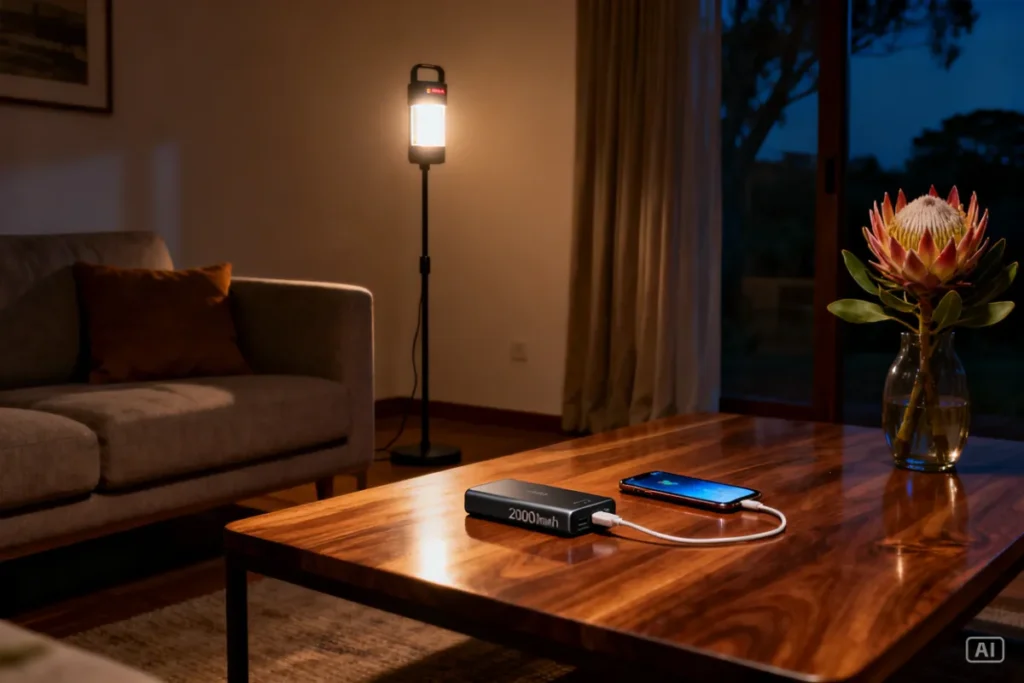
Step-by-step: How to maintain your load shedding power bank
A lithium-ion battery requires basic care to ensure it does not degrade quickly after just a few months of intense Eskom schedules. You want to keep the internal cells healthy so it holds a maximum charge when you desperately need it.
Follow these straightforward maintenance steps to double the lifespan of your portable charger:
- Avoid zero percent: Try not to let the power bank drain completely flat to 0%. Plug it into the wall when the indicator lights drop to one bar (around 25%).
- Charge it immediately: As soon as the power comes back on after a load shedding slot, plug the bank into a fast wall charger so it is ready for the next round.
- Keep it cool: Never leave your power bank sitting on the dashboard of your car in the blazing South African summer sun, as extreme heat destroys lithium cells.
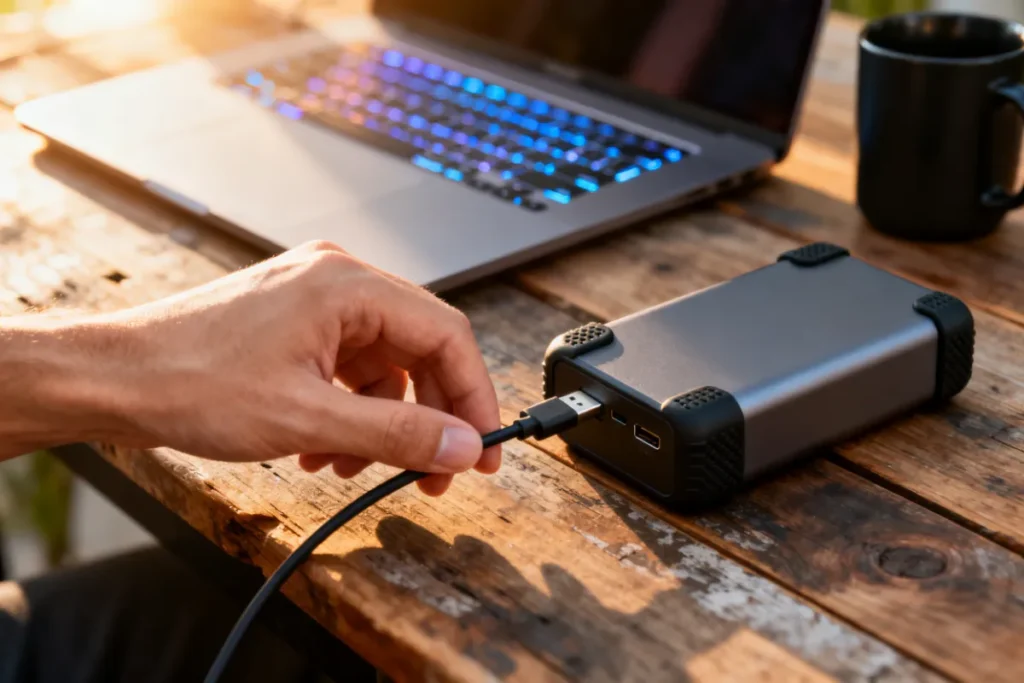
- Use the right cable: Always use a high-quality, thick USB cable to charge the bank, as cheap cables slow down the charging process drastically.
- Cycle it occasionally: If you are lucky enough to have a break from load shedding, drain the power bank halfway and recharge it once a month to keep the battery chemistry active.
Comparing standard chargers against the Best Power Banks for Load Shedding
A high-quality load shedding power bank features fast-charging technology and multiple output ports, whereas a standard cheap charger drips power slowly and only handles one device at a time. When you only have a two-hour window of electricity to recharge your gear, speed is absolutely everything.
Standard power banks take up to twelve hours to refill themselves from the wall. A dedicated fast charging power bank load shedding model uses Power Delivery (PD) to recharge itself in a fraction of the time, ensuring it is full before the next power cut hits.
| Feature | Premium Load Shedding Power Bank | Cheap Supermarket Power Bank |
| Capacity | 20,000mAh – 30,000mAh | 2,000mAh – 5,000mAh |
| Charge Speed | 18W – 65W Fast Charging (PD/QC) | 5W Standard Slow Charging |
| Multiple Devices | Yes (3+ ports simultaneously) | No (Usually only 1 port) |
| Recharge Time | 3 to 5 hours (with PD charger) | 8 to 12 hours |
Recommended solutions for your backup power needs
Choosing the right brick comes down to what devices you actually own and how heavily you use them during an outage. You want hardware from reputable brands that will not overheat or short-circuit your expensive electronics.
For the average household wanting to keep a few cell phones and a USB light running, a reliable 20000mAh Fast Charge Power Bank is the perfect balance of portability and massive capacity. If you work from home and need to keep your MacBook or Dell running when the wall sockets die, you must invest in a heavy-duty 65W Laptop Power Bank South Africa. To see how these portable chargers integrate into your entire home backup strategy, make sure to read our Essential Gadgets Every Home Needs During Load Shedding for a complete breakdown of what works.
Zack’s Verdict
Trying to survive Stage 6 load shedding without a proper, high-capacity portable charger is just making your life unnecessarily difficult. It is the cheapest, easiest, and most immediate way to guarantee you stay connected to the outside world when the grid collapses.
I see too many people buying tiny, cheap battery sticks that die before their phone even hits 50%. Do yourself a massive favour and spend a few extra Rands on a heavy-duty 20,000mAh unit with fast charging. It will permanently eliminate that sinking feeling you get when your phone flashes a low battery warning in the dark. Buy the right gear once, keep it charged, and take back your peace of mind.
Frequently Asked Questions
Understanding battery specs, charging speeds, and capacity limits can be frustrating when you just want to keep your phone alive. Here are the straight, practical answers to the most common questions South Africans ask about portable chargers.
- How many times will a 20,000mAh power bank charge my phone?A true 20,000mAh unit will fully charge a standard modern smartphone (like an iPhone 14 or Samsung Galaxy S23) roughly four times from zero to 100%.
- Why does my power bank take so long to recharge from the wall?You are likely using an old, slow 5W wall adapter. To recharge a massive battery quickly, you must plug it into a 20W or higher fast-charging wall brick using a good quality cable.
- Can a power bank run my Wi-Fi router?Yes, but only if you buy a specific DC step-up cable (usually 5V to 12V) that fits your router. However, buying a dedicated mini UPS is a much safer and more reliable solution for routers.
- What does PD or QC mean on the box?PD stands for Power Delivery, and QC stands for Quick Charge. Both are technologies that allow the power bank to push energy into your phone much faster than standard charging, provided your phone supports it.
- Is it safe to charge my phone while the power bank is charging from the wall?This is called “pass-through charging.” While some high-end models support it, it generally generates a lot of heat and degrades the battery cells faster. It is better to charge them separately.
- Can a standard power bank charge my laptop?No, a standard 10W or 18W unit will not charge a laptop. You specifically need a laptop power bank South Africa model that outputs at least 45W or 65W via USB-C Power Delivery.
- Why did my cheap power bank swell up and crack?Cheap models use poor-quality lithium polymer pouches that produce gas and swell when they overheat or degrade. If your power bank bulges, stop using it immediately and recycle it safely, as it is a severe fire hazard.
Conclusion
You do not have to accept the stress of a dead phone every time the national grid fails. Grabbing a high-capacity portable charger is a simple, affordable fix that ensures your digital life continues uninterrupted, no matter what schedule we are on.
By investing in a fast-charging, large-capacity brick, you guarantee that your family stays safe, entertained, and connected during the darkest hours. Head over to Zacks Bargains to browse our range of tough, reliable power banks that have been specifically chosen to survive the harsh realities of South African load shedding.