An honest Solar wifi camera review for South African homes
When you are trying to secure your property against criminals who specifically target load shedding schedules, finding a reliable off-grid solution is critical. Reading a proper Solar wifi camera review is the best way to separate the cheap, useless plastic toys from the heavy-duty security gear that actually works in our harsh African climate. Eskom has made traditional wired CCTV systems completely obsolete because standard backup batteries degrade and die within a few months of daily Stage 6 abuse. You need an independent, sun-powered perimeter defense that never blinks, never goes offline, and keeps your family safe even when the entire suburb goes completely dark.
What to look for in a proper Solar wifi camera review
Any honest Solar wifi camera review should focus entirely on battery capacity, solar panel efficiency, and PIR motion sensor accuracy in real-world South African conditions. If a review only talks about how the camera looks out of the box, it is completely useless for someone trying to secure a dark driveway during a blackout.
You need to know if the internal lithium batteries are massive enough to keep the infrared night vision running through a long, overcast winter weekend. The PIR (Passive Infrared) sensor is also crucial, as it detects human body heat rather than just visual movement. A quality sensor ensures you do not get fifty false alarm notifications on your phone every time a neighborhood cat walks along your boundary wall.
The main solar camera pros and cons you need to know
The biggest advantage of a wireless solar security camera is the completely wire-free installation and immunity to load shedding, but the main drawback is its reliance on your home Wi-Fi network. You can mount these cameras literally anywhere on your property without hiring a sparky or drilling massive holes for messy cables.
Because they run entirely on free solar energy, they cost absolutely nothing to operate on a daily basis. However, because they are Wi-Fi devices, they are only as good as your router’s signal strength. If you mount the camera too far away from the house, or if your router dies during a power cut because you do not have a backup battery, the camera cannot send live alerts to your phone.
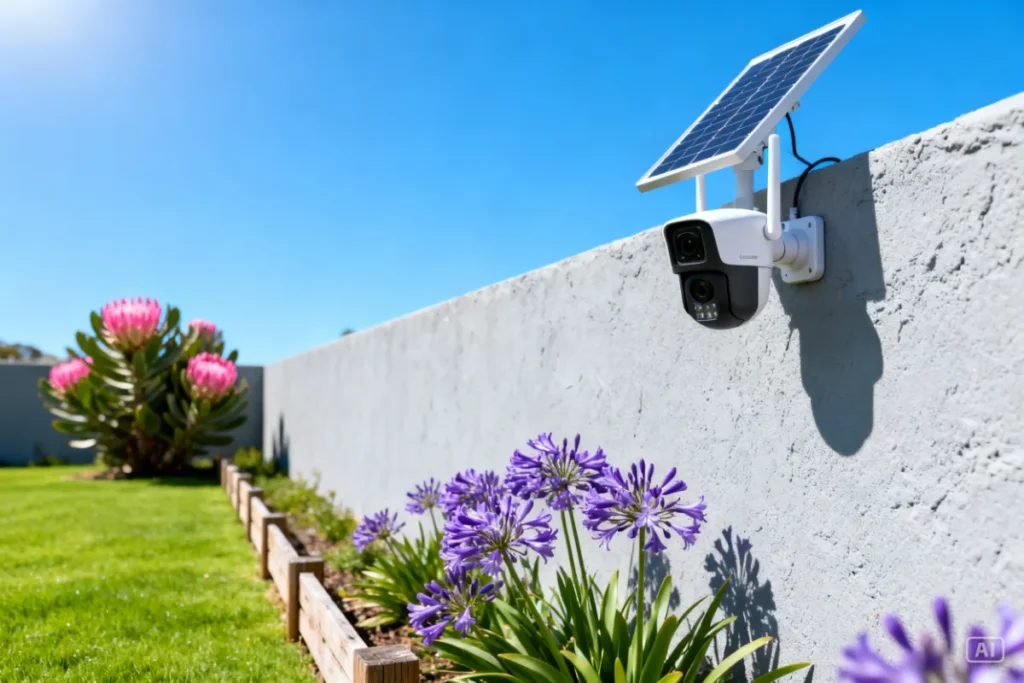
Step-by-step: Installing your load shedding wifi camera
Installing this off-grid technology is a quick, straightforward DIY job that you can easily finish on a Saturday morning. You do not need to pull cables through your ceiling or mess around with your main distribution board to get professional-grade security.
Follow this simple sequence to get your perimeter locked down correctly the very first time:
- Check the signal: Before drilling anything, hold your smartphone exactly where you want to mount the camera and make sure you have at least two bars of Wi-Fi signal.
- Charge it up: Plug the camera into a wall charger inside the house to ensure the internal battery is at 100% before you mount it outside.
- Mount the bracket: Drill three small holes into your brickwork, tap in the wall plugs, and screw the mounting bracket securely into place.
- Position the panel: Attach the solar panel and angle it directly towards the north so it catches the maximum amount of direct sunlight throughout the day.
- Sync and test: Open the smartphone app, scan the camera’s QR code to connect it to your network, and walk across your yard to test the motion detection zones.
Comparing off-grid tech in this Solar wifi camera review
To make this Solar wifi camera review completely objective, we must compare this modern wireless technology directly against old-school wired CCTV systems. Standard wired cameras require a central DVR box and constant grid electricity, making them highly vulnerable during extreme load shedding schedules.
Wired systems are expensive to install and incredibly frustrating to maintain when their heavy lead-acid backup batteries inevitably fail. A sun-powered system operates as a completely independent unit, meaning if one camera is damaged or stolen, the rest of your security network remains fully operational.
| Feature | Off-Grid Solar Wi-Fi Camera | Traditional Wired CCTV |
| Grid Vulnerability | Zero (Runs entirely on the sun) | High (Fails when backup battery dies) |
| Installation | Quick, DIY, completely wireless | Expensive, requires professional cabling |
| Video Storage | Local SD card or Cloud app | Bulky, loud central hard drive |
| Running Cost | Free daily operation | High maintenance & battery replacement |
Recommended solutions for your home security
When choosing a camera for your property, you must buy rugged, weather-resistant hardware that features a high-capacity lithium battery and a highly sensitive PIR heat sensor. You want a device that instantly sends a crisp, clear video to your phone the second an intruder steps onto your grass, without lagging or disconnecting.
This is exactly why we highly recommend grabbing a Wi-Fi Solar Camera for your main entry points. This is one of the most popular setups we are seeing locally right now because it provides incredible 4K video quality without the massive price tag. It features simple plug-and-play installation, meaning there is no complicated wiring and no electrician required to secure your home. It is absolutely perfect for townhouses, remote workers, or renting tenants who want a robust system they can unscrew and take with them when they move.
However, you must remember that a Wi-Fi camera needs an active router to send alerts. We strongly advise pairing your new cameras with a Mini UPS for WiFi Router to ensure your internet stays online during blackouts. To see how these two devices work perfectly together to secure your perimeter, make sure to read our Essential Gadgets Every Home Needs During Load Shedding for a complete home defense strategy.
Zack’s Verdict
Honestly, holding onto an outdated wired camera system that dies every time Eskom trips is just giving criminals exactly what they want. You are paying a premium for a false sense of security. Upgrading to independent, sun-powered cameras is the cheapest, most effective way to take back control of your perimeter.
I see okes stressing about crime levels on community WhatsApp groups every single day, yet their driveways are completely dark and unmonitored during Stage 6. Stop being a soft target. Buy a couple of solid solar cameras, mount them high up on your walls, and guarantee that your property is always watching, even when the neighborhood is pitch black.
Frequently Asked Questions
Understanding battery limits, Wi-Fi ranges, and data usage is vital before you commit to upgrading your security. Here are the straight, honest answers to the most common queries we get regarding off grid security camera review discussions.
- Will the camera work if my Wi-Fi router turns off during load shedding?If your router dies, the camera will still wake up, detect motion, and record the video locally to its internal SD card. However, it cannot send the live notification to your phone until the Wi-Fi comes back online.
- How far away from the router can I mount the camera?This depends heavily on your walls, but standard 2.4GHz Wi-Fi can usually punch through one or two brick walls and reach a camera mounted about 10 to 15 meters away in the yard.
- Does the solar panel charge the battery on cloudy days?Yes, high-quality panels will still draw a small amount of ambient UV light through the clouds to trickle-charge the battery, though it is significantly slower than direct, bright sunlight.
- What happens if a criminal steals the camera off the wall?Because the PIR sensor triggers instantly, the camera will have already recorded their face and uploaded the clip to your phone or the cloud before they even reach the mounting bracket.
- Do these cameras use a lot of my home internet data?No, they use very little data. They do not stream 24/7 like old CCTV systems; they only use data when uploading a 10-second motion clip or when you manually open the app to check the live feed.
- How often do I need to replace the internal lithium battery?A quality lithium battery managed correctly by a solar panel should easily last between three to five years before you notice any significant degradation in its charge capacity.
- Can I view the live camera feed while I am away at work?Absolutely. As long as your camera is connected to your active home Wi-Fi, you can open the app and view the live feed from anywhere in the world using your smartphone data.
- Is the motion detection going to trigger every time it rains?No, modern solar cameras use PIR (Passive Infrared) sensors that strictly detect human body heat, meaning they completely ignore rain, wind, moving shadows, and blowing branches.
Conclusion
Securing your South African home does not have to involve messy cables, expensive installers, or relying on a failing national grid. Wireless, sun-powered security technology puts the control firmly back in your hands, offering a robust perimeter defense that thrives precisely when the streetlights fail.
By strategically placing these smart cameras around your property and keeping your Wi-Fi active, you guarantee your family is never left completely blind in the dark. Head over to Zacks Bargains to browse our range of tough, tested off-grid security cameras and lock down your home with gear you can actually trust.