Solar Security Camera Price South Africa: What You Should Expect to Pay in 2026
If you’ve started searching for solar security camera price South Africa information and found nothing but vague overseas figures in dollars or pounds, you’re not alone. Most price guides online are useless for SA buyers — they don’t account for rand exchange rates, local import costs, or the specific tiers available in the South African market right now. This guide gives you honest, current, rand-denominated pricing across every tier, explains exactly what you get at each price point, and tells you where the value actually lives for a South African household budget.
Solar Security Camera Price South Africa: The Four Tiers Explained
The SA solar camera market in 2026 breaks cleanly into four price tiers. Each tier represents a genuine step up in capability — this isn’t just marketing. Here’s what the money actually buys you:
| Tier | Price Range | Resolution | Night Vision | Panel | Battery | Storage | Best For |
|---|---|---|---|---|---|---|---|
| Budget | R600–R950 | 1080p | IR (B&W) | 1–2W | 4,000–6,000 mAh | Cloud only | Low-risk secondary positions |
| Mid-Range | R1,200–R1,800 | 2K | Colour + spotlight | 3–5W | 10,000–15,000 mAh | SD card + cloud | Gates, driveways, main entries |
| Premium | R2,500–R4,000 | 4K | Colour + spotlight + AI | 6W+ | 15,000+ mAh | SD + cloud + NAS | Large properties, high-risk areas |
| Professional | R4,500+ | 4K multi-cam | Full colour AI | 6W+ per unit | System-level | NVR + cloud | Businesses, farms, estates |
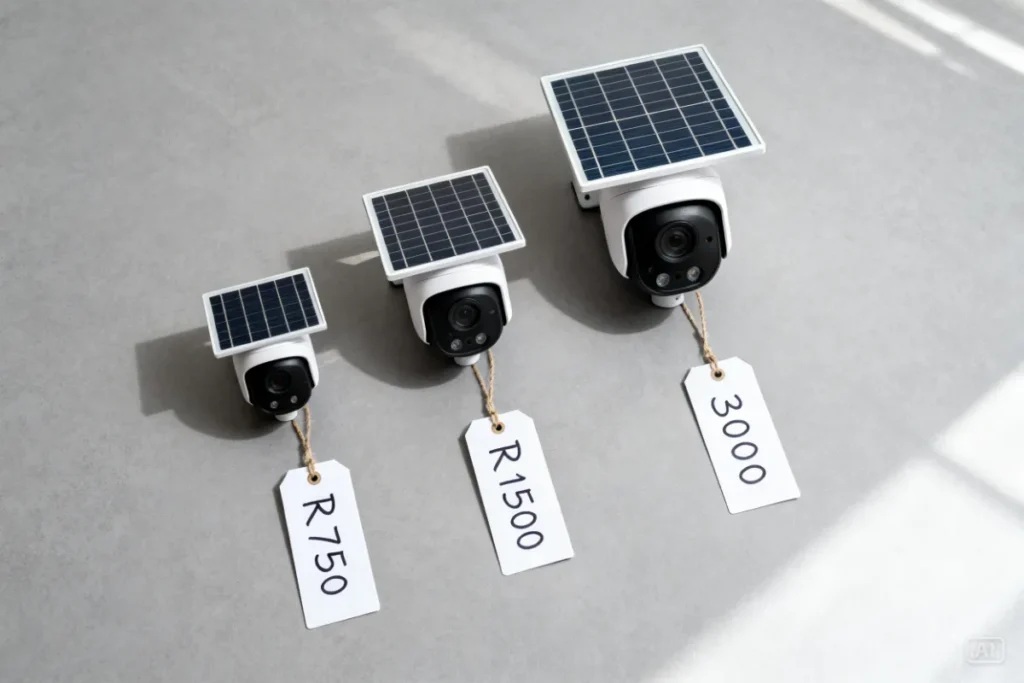
The single most important thing this table shows: the jump from budget to mid-range is the most significant upgrade you can make. The difference between a R750 camera and a R1,500 camera is enormous in real-world performance. The difference between a R1,500 camera and a R3,500 camera is meaningful but incremental. Spend to the mid-range minimum — it’s the floor, not the ceiling.
What Does a Budget Solar Camera (R600–R950) Actually Get You?
At the budget end of the solar security camera price South Africa market, you’re buying a starting point — not a complete solution. These cameras work, but with real limitations that matter in South African conditions.
You get 1080p resolution, which is adequate for detecting that someone is present but rarely sharp enough to capture a usable number plate or identify a face beyond 4–5 metres. Night vision is infrared — black and white, with a typical useful range of 8–12 metres. The solar panel is small, usually 1–2W, which means battery top-up is slow and cloudy days genuinely affect performance. Most budget cameras store footage on cloud only, which means a monthly subscription after a 30-day free trial — a hidden cost that erodes the apparent saving at purchase.
These cameras are not worthless. They work well as secondary cameras on low-risk positions — a back garden, an outbuilding, a pool area — where you mainly need confirmation that something moved rather than forensic-quality footage. But as a primary camera on your gate or driveway, a budget unit will leave you frustrated within three months.
The Mid-Range Sweet Spot: R1,200–R1,800
This is where the South African solar camera market delivers genuine value, and it’s the tier we point the overwhelming majority of SA buyers toward. At R1,200–R1,800 you get a setup that handles every meaningful challenge a South African property throws at it.
Resolution steps up to 2K — sharp enough for clear number plate capture at 8–10 metres and face identification at 5–7 metres. Night vision switches from IR black-and-white to colour with a built-in LED spotlight, which is transformative for after-dark footage quality. The solar panel runs at 3–5W, charging the battery fully on a standard Joburg or Pretoria sunny day and carrying the camera comfortably through 2–3 days of overcast weather or load shedding without issue. Local SD card storage means no subscription fees — buy a 64GB micro SD card once and you’re covered for 7–14 days of rolling footage at no ongoing cost.
For most South African homes — townhouses, freestanding suburban properties, rental units — one or two cameras in this tier covers your security needs completely. The 4K Solar Camera sits at the upper end of this range and delivers 2K resolution with all the features above plus AI person and vehicle detection that eliminates the false alerts that plague budget motion sensors.
Premium Solar Cameras (R2,500–R4,000): When Is It Worth It?
Premium solar cameras earn their price tag in specific situations. If your property is large, your risk profile is high, or you need footage quality that holds up unambiguously for legal or insurance purposes, the step up to premium makes sense.
At this tier you get true 4K resolution — detailed enough to read a number plate clearly at 15+ metres and capture facial features that are genuinely usable as evidence. AI detection at premium level filters not just by person and vehicle but by behaviour — lingering, perimeter crossing, specific zone entry — which dramatically reduces false alerts on busy properties. Panels run at 6W or more, making battery management essentially a non-issue even through Cape Town winters. Dual storage — both local SD and cloud simultaneously — means footage is backed up off-site automatically.
The premium tier makes sense for: larger freestanding homes with extended perimeters, smallholdings and farms, high-crime area properties, landlords managing multiple units, and small business owners who need footage quality that satisfies insurance requirements. For a standard suburban townhouse, it’s more camera than you need.
Hidden Costs to Factor Into Your Solar Camera Budget
The sticker price is not the full cost. These are the additional expenses SA buyers regularly overlook:
Micro SD card — most mid-range and premium cameras don’t include one. Budget R80–R150 for a quality 64GB card. Don’t skip this — cloud-only storage is not a reliable primary backup in SA conditions.
Cloud subscription — if your camera requires cloud storage, the free tier typically lasts 30 days. Ongoing subscriptions run R50–R150 per month per camera depending on the platform. Choose cameras with local SD storage to avoid this entirely.
WiFi extender — if your mounting position is at the edge of your WiFi range, a basic extender costs R300–R600 and is cheaper than buying a 4G-enabled camera. Test your signal at the install point before spending.
Mini UPS for your router — not a camera cost, but essential for load shedding resilience. A Mini UPS that keeps your router live during outages costs R300–R500 and is one of the highest-value additions to any SA home security setup.
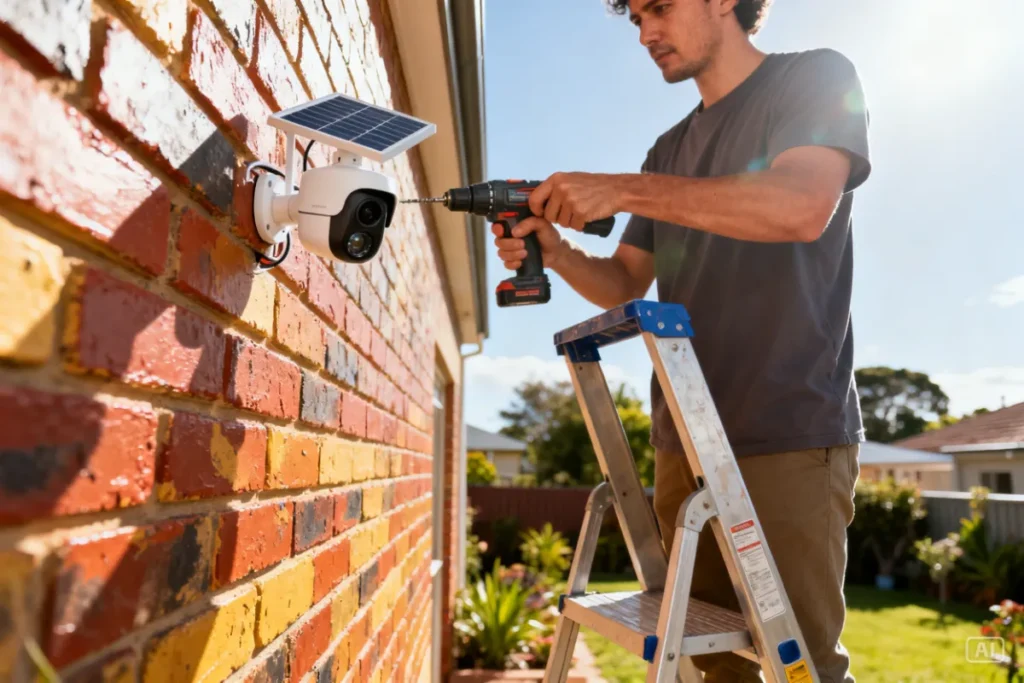
Installation — solar cameras are designed for DIY installation and require no electrician. The only tools you need are a drill, wall plugs, and a Phillips screwdriver. Factor zero labour cost into your budget.
Solar Security Camera Price South Africa: Is Cheaper Always Worse?
Not always — but usually in the ways that matter most for SA buyers. The honest answer is that the cheap end of the market has improved significantly since 2022. A R750 camera today performs better than a R750 camera did three years ago. The problem is that the mid-range has also improved, and the gap between the two tiers has widened in real-world performance even as the price gap has narrowed.
The specific areas where budget cameras still fall short for South African conditions are exactly the areas that matter most locally: night vision quality during load shedding hours, battery performance through extended cloudy periods, and storage reliability without a subscription. These aren’t minor inconveniences — they directly affect whether your camera captures usable footage during the exact circumstances you bought it for.
Spend R1,200–R1,500 minimum for any camera covering a gate, driveway, or primary entry point. Save money elsewhere in your setup — on the SD card brand, on whether you need two-way audio, on pan-and-tilt features you probably won’t use. Don’t save on the camera that covers your front gate.
Step-by-Step: How to Build a Complete SA Home Security Camera Setup on a Budget
You don’t need to spend R10,000 to cover a standard South African home properly. Here’s how to do it intelligently on a realistic budget:
- Start with one camera at your highest-risk point. For most SA homes that’s the front gate or driveway entrance. Budget R1,400–R1,600 for a mid-range 2K unit with colour night vision and SD storage.
- Add a Mini UPS for your router. R300–R500. This keeps remote viewing and alerts live during load shedding — the single most impactful add-on for SA homeowners.
- Buy a 64GB micro SD card. R80–R150. Local backup that runs indefinitely with no subscription.
- Add your second camera at the next highest-risk point. Side passage or back access. Another R1,400–R1,600.
- Review your GSC footage after 30 days. Check which areas your existing cameras miss. Add a third camera only if there’s a clear uncovered entry point — don’t add cameras for the sake of it.
Total for a practical two-camera setup with router backup: R3,200–R4,000. That covers the most common break-in routes on a standard SA residential property at mid-range quality, with no ongoing subscription fees.
Recommended Solution: Best Value for SA Buyers Right Now
For South African homeowners looking for the best balance of price and performance, the 4K Solar Camera delivers everything the mid-range tier promises — 2K resolution, colour night vision with LED spotlight, 5W solar panel, local SD card storage, and AI motion detection — at a price that makes sense for an SA household budget. This is consistently the most popular camera we’re seeing SA buyers choose right now, particularly for primary gate and driveway coverage where night performance and load shedding resilience are non-negotiable. No electrician, no subscription fees, no Eskom dependency. Plug-and-mount installation in under 30 minutes. For a full breakdown of every feature category and how they compare across tiers, the Ultimate Guide to Solar Security Cameras in South Africa covers the complete picture.
Zack’s Verdict
Here’s the honest pricing truth for South African buyers: R1,200–R1,800 is the number you should have in your head before you start shopping. Below that and you’re compromising on the exact things that matter most in SA — night vision quality, battery backup, and local storage. Above R1,800 you’re getting real upgrades, but nothing that changes the fundamental security outcome for a standard suburban home. The mid-range is where South African value lives. Don’t let a R400 saving at the bottom of the market cost you usable footage when you actually need it.
FAQ: Solar Security Camera Price South Africa
Q: What is the average price of a solar security camera in South Africa in 2026? The average price for a mid-range solar security camera in SA currently sits between R1,200 and R1,800. Budget models start around R600–R950 and premium units run R2,500–R4,000. For most homeowners, the R1,400–R1,600 range delivers the best balance of performance and value.
Q: Are solar cameras more expensive than traditional wired CCTV in South Africa? For a single camera, solar cameras are comparable in price to wired alternatives at the same quality level. The significant difference is installation cost — wired CCTV requires cable runs and often a professional installer, which can add R1,500–R3,000 in labour costs. Solar cameras are DIY and require no electrician, making the total cost of ownership considerably lower.
Q: Do cheaper solar cameras have hidden ongoing costs? Often yes. Budget cameras frequently offer cloud-only storage with a free trial period, after which you pay R50–R150 per month per camera. Over 12 months that adds R600–R1,800 to the true cost of a R750 camera. Always check storage options before buying — a camera with a local SD card slot eliminates this ongoing expense entirely.
Q: Is it worth buying two budget cameras instead of one mid-range camera? Generally no. Two budget cameras covering two positions sounds logical, but both will underperform on night vision and battery backup — the two most critical factors in SA conditions. A single well-positioned mid-range camera covering your highest-risk entry point outperforms two budget units in the scenarios that actually matter. Start with one good camera and expand from there.
Q: Do solar camera prices vary between summer and winter in South Africa? Not significantly based on season, but stock availability and pricing can shift around key retail periods. Load shedding escalations — when Eskom announces extended high stages — typically drive a short-term spike in demand and occasionally affect availability at the budget end of the market. Buying outside these spikes can sometimes secure better value.
Q: Can I get a decent solar camera for under R1,000 in South Africa? You can, but with meaningful compromises. A R750–R950 camera works as a secondary unit at a low-risk position. For a primary gate or driveway camera, the compromises at sub-R1,000 — IR-only night vision, small battery, no local storage — make it a false economy for most SA homeowners.
Q: Are imported solar cameras cheaper and worth the risk? Imported cameras from overseas platforms can appear cheaper at first glance but the total landed cost — shipping, import duties, VAT — often closes the gap significantly. More importantly, after-sales support is non-existent if the unit fails. Buying locally through a SA retailer with a clear return and warranty policy is worth the modest price difference.
Q: How much should I budget for a complete two-camera SA home setup? A practical, no-compromise two-camera mid-range setup — covering gate and a secondary entry point, with SD storage and a router UPS — comes to R3,200–R4,000 all in. That includes both cameras, SD cards, and the Mini UPS for load shedding resilience. No ongoing subscription fees after that initial outlay.
Conclusion: Know Your Number Before You Shop
The solar security camera market in South Africa has never offered better value than it does right now — but only if you spend at the right tier. Go in with R1,200–R1,800 as your per-camera budget for any primary security position, factor in the small add-ons that make a real difference in SA conditions, and you’ll build a setup that works through load shedding, through Highveld storms, and through the hours when South African properties are most at risk.
Browse the full solar camera range at Zacks Bargains — every unit is rand-priced, locally supported, and selected for South African conditions.